ข้ามไปที่เนื้อหา
A coffee bean packaging machine must do more than put beans into a bag: it must weigh consistently, limit unnecessary impact, protect the seal area, and support the intended freshness strategy.
Quick answer: For most whole-bean applications, pair a tested weighing system with either VFFS for rollstock bags or a premade-pouch machine for converted retail pouches. Validate bean breakage, weight distribution, valve position, residual oxygen when flushing, seal integrity, and sustained saleable output with your actual beans and bags.
This article goes deeper than our coffee packaging machine guide and focuses on one specific equipment decision.
Choose the Packaging Route First
| Route | Best fit | Main verification |
|---|---|---|
| Semi-automatic weighing and sealing | Short runs and frequent SKU changes | Complete operator cycle and seal consistency |
| VFFS | Stable formats and repeatable rollstock production | Film, forming set, valve method, height, changeover |
| Premade-pouch machine | Zipper, flat-bottom, or pre-valved premium bags | Pickup, opening, valve/gripper clearance, pouch tolerances |
| Bulk bag system | Wholesale or foodservice quantities | Bag support, weight range, closing method |
Select the Bean Weighing System
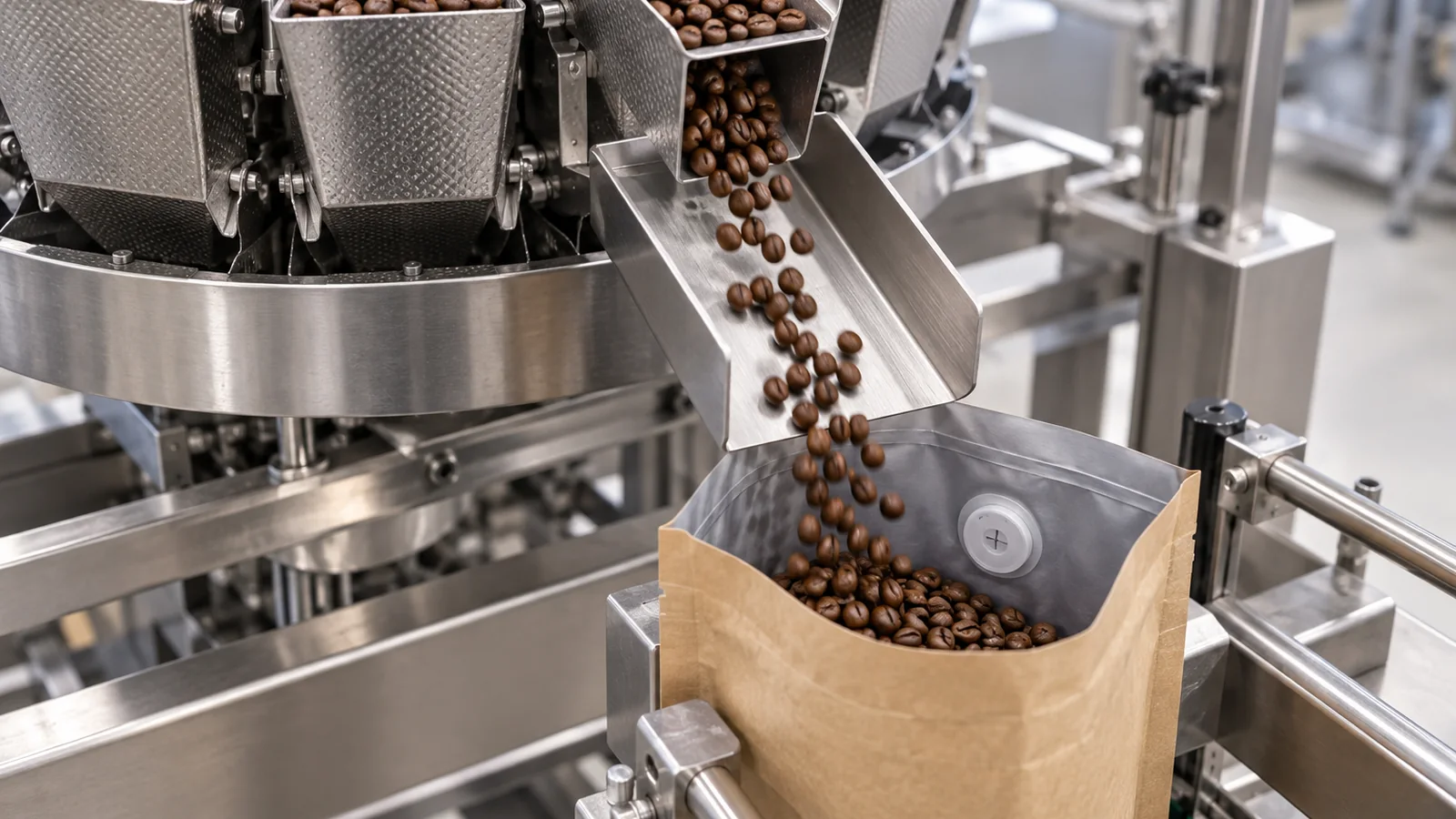
Multihead weigher
Multiple weigh heads create a combination close to the target. It can support higher output and multiple target weights, but evaluate drop height, surface contact, cleaning, and bean breakage.
Linear weigher
Linear channels can be a practical moderate-output route. Check feeding stability as bean size, roast, and surface oil change.
Net weigher
A net weigher prepares a dose before releasing it into the pack. It may suit larger weights or applications where controlled discharge is important.
Protect Beans During Transfer
Map every fall, chute, gate, and impact point from hopper to bag. “Gentle” should be converted into a measurable trial: inspect broken material before and after the line under the agreed product condition. Also confirm that oily beans do not build up on contact surfaces or alter feed behavior during a run.
Treat the Coffee Bag as a Machine Component
| Bag feature | Machine consequence |
|---|---|
| One-way valve | May interfere with grippers, guides, forming, or seals |
| Zipper | Requires opening clearance and controlled fill position |
| Flat bottom or gussets | Needs correct presentation, opening, and support |
| High-barrier laminate | Must have a workable sealing window |
| Printed rollstock | Needs compatible web width and registration control |
Nitrogen Flushing and Degassing Valves Have Different Jobs
Nitrogen flushing reduces oxygen-rich air before closure. A one-way degassing valve manages carbon dioxide released after packaging. One does not replace the other automatically.
Define residual oxygen, measurement method, sampling time, gas source, flow, package size, and line speed. For valves, confirm location, flow characteristics, application method, and mechanical clearance. Base shelf-life decisions on product and package validation, not on the presence of a gas nozzle.
Capacity Means Saleable Bags, Not Maximum Cycles
Specify bags per shift, fill weights, SKUs, changeovers, replenishment, cleaning, and downstream handling. The weigher may cycle quickly while the bagger waits for a pouch, gas flush, or seal. Request a sustained run with agreed intervention rules.
| Metric | Why it matters |
|---|---|
| Stable bags per minute | Shows complete-system capability |
| Average and variation | Shows control of compliance and giveaway |
| Broken-bean change | Shows handling consequence |
| Residual oxygen | Shows atmosphere-control result |
| Seal and reject rate | Shows package quality |
| Changeover time | Shows multi-SKU flexibility |
When a Simpler Machine Is Better
A semi-automatic cell may be the stronger choice when you run small seasonal lots, use many pouch formats, or need visual operator control. Automatic feeding is not valuable if changeovers and pouch variability dominate the shift.
Coffee Bean Machine RFQ Checklist
- Bean size range, roast profiles, oil condition, temperature, and sample
- Target weights and tolerance policy
- Bag drawings, production samples, zipper and valve positions
- Saleable output per shift and SKU schedule
- Nitrogen and residual-oxygen requirements
- Breakage, seal, weight, and reject acceptance criteria
- Utilities, layout, ceiling height, and downstream scope
- Training, documentation, change parts, and spare parts
Prepare the Information for an Application Review
Send Hualian your coffee type, fill weight, package drawings and samples, target saleable output, SKU schedule, utility information, and required inspection scope. These inputs allow the engineering team to define a testable configuration instead of assuming that a standard machine will fit.
Frequently Asked Questions
What filler is best for whole coffee beans?
Whole beans are commonly dosed by multihead, linear, or net weighing systems. The best option depends on weight range, output, breakage, and cleaning.
Do coffee bean bags need a one-way valve?
It depends on roast, time before packing, package design, and distribution. Confirm the degassing strategy with product testing.
Does nitrogen flushing replace a valve?
No. Flushing manages the initial atmosphere; a valve releases gas generated after closure.
Can VFFS make valve bags?
Some configurations can apply or accommodate valves, but the exact film, valve, location, and application method require testing.
How should capacity be verified?
Use a sustained run with actual beans and bags, defined interventions, and saleable-pack criteria.