Ir para o conteúdo

Escolher uma máquina de embalagem de café não é simplesmente uma questão de encontrar equipamentos que possam encher e selar um saco. Você está selecionando um sistema de produção que afetará a consistência do peso de enchimento, a frescura do café, a aparência da embalagem, os requisitos de mão-de-obra e sua capacidade de aumentar a produção no futuro.
Nossa visão é simples: Você não deve selecionar a máquina primeiro. Comece definindo o café que você precisa empacotar, a embalagem acabada que você deseja vender, a saída utilizável que sua fábrica deve alcançar e o ponto em que a automação deve começar e terminar. Só então você pode comparar sistemas de dosagem, máquinas de ensacamento, selantes, opções de descarga de nitrogênio e equipamentos a jusante.
Resposta rápida: Combine a máquina com quatro requisitos: formato de café, pacote acabado, saída de produção utilizável e escopo de automação. Os grãos inteiros normalmente usam um sistema de pesagem, enquanto o café moído geralmente usa um enchimento de trado. Você também deve verificar a compatibilidade do saco, a qualidade do selo, o oxigênio residual, o tempo de troca e a saída sustentada com o produto real e o material de embalagem.
O que é uma máquina de embalagem de café?
Uma máquina de embalagem de café é um equipamento industrial usado para medir, encher e fechar pacotes contendo grãos de café inteiros, café moído ou café instantâneo. Dependendo do nível de automação, um sistema pode lidar com alimentação de produtos, pesagem ou dosagem, formação ou abertura de sacos, enchimento, descarga de nitrogênio, vedação, codificação, inspeção, embalagem de caixas e paletização.
Uma pequena torrefadora pode precisar apenas de uma unidade de pesagem automática e um Saco contínuo máquina de vedação. Uma fábrica de café maior pode precisar de uma linha conectada que se mova da alimentação e pesagem do produto até a inspeção, embalagem e paletização.
Máquinas de embalagem de café não são cafeteiras
Uma máquina de café ou máquina de café expresso prepara uma bebida. Um torrefador de café desenvolve o sabor dos grãos verdes e um moedor reduz os grãos torrados a um tamanho de partícula selecionado. Uma máquina de embalagem de café industrial começa seu trabalho após a torrefação e, quando aplicável, moagem. Seu trabalho é colocar o café em uma embalagem protetora e vendável com o peso, a aparência e o desempenho de vida útil necessários.
Explore o cluster de tópicos de embalagens de café
Use esses guias focados para passar da compreensão básica do equipamento para uma lista restrita que se adapte ao seu escopo de café, pacote, produção e investimento.
Entenda o equipamento
- Tipos de máquinas de embalagem de café e suas aplicações
- Como funciona uma máquina de embalagem de café
Escolha por produto e escala de produção
- Como escolher uma máquina de embalagem de café
- Máquina de embalagem de café guia de compra
- Máquina de embalagem de café moída guia de compra
- Máquinas de embalagem de café para pequenas empresas
- Máquinas de embalagem de café para produção de alto volume
Plano de preservação e investimento
- Sistemas de descarga de nitrogênio para embalagens de café
- Custo da máquina de embalagem de café e escopo do projeto
Defina quatro requisitos antes de comparar máquinas
Muitos compradores começam comparando velocidades e preços da máquina. Acreditamos que isso coloca a decisão na ordem errada. Comece com o produto e a embalagem acabada; a máquina deve seguir esses requisitos.
1. Que tipo de café você está embalando?
| Produto do café | Principais desafios da embalagem | Abordagem de dosagem comum |
|---|---|---|
| grãos de café inteiros | Forma irregular, quebra, óleo e desgaseificação | Enchimento de peso múltiplo, linear ou líquido |
| Chão de café | Poeira, mudanças de densidade e produto na área de vedação | Maior preenchimento |
| Grânulos de café instantâneo | Sensibilidade à umidade e danos por partículas | Pesagem ou dosagem volumétrica |
| Café instantâneo em pó | Poeira, sensibilidade à umidade e fluxo variável | Maior preenchimento |
Os grãos inteiros são normalmente tratados como um produto granular, mas a altura de transferência e o manuseio ainda são importantes porque o movimento agressivo pode danificá-los. O café moído se comporta de maneira diferente: seu desempenho de dosagem depende do tamanho da moagem, da densidade do volume, da umidade e do ar aprisionado.
É por isso que uma afirmação como “adequado para café” não é suficiente. Você deve perguntar qual formato de café foi testado e sob quais condições.
2. Qual pacote finalizado você precisa?
Formatos comuns incluem sacos de travesseiro, sacos de reforço lateral, sacos de fundo plano, bolsas de pé, bolsas de zíper pré-fabricadas, saquetas, pacotes de pau, sacos a granel, latas e frascos.
Se você já usa uma bolsa pré-fabricada impressa com um zíper e uma válvula de desgaseificação unidirecional, a máquina deve escolher, abrir, posicionar, preencher e selar essa bolsa específica de forma confiável. Se você quiser formar sacos de material rolante, a estrutura do filme, dimensões do rolo, marcas de registro e geometria de saco necessária tornam-se parte da especificação da máquina.
3. Qual saída de produção utilizável você precisa?
Não defina a produção apenas como sacos por minuto. Forneça sacos alvo por turno, peso de enchimento, minutos de produção disponíveis, contagem de SKU, trocas por dia, pessoal atual e crescimento esperado.
Uma velocidade máxima declarada não é o mesmo que a saída vendável. O tempo de produção é perdido durante o reabastecimento de material, trocas, limpeza, correções de peso, recuperação de falhas e paradas a jusante. Uma máquina de velocidade mais baixa que funciona consistentemente pode fornecer pacotes mais aceitáveis do que uma máquina mais rápida que pára com frequência.
4. Onde a automação deve começar e terminar?
“Uma cotação pode cobrir apenas um empacotador, enquanto outra inclui dosagem, lavagem de nitrogênio, codificação, inspeção e descarga. Defina se você precisa apenas de dosagem, enchimento e vedação, embalagem primária automática, inspeção, embalagem de caixa ou uma linha completa através de paletização.

Principais tipos de máquinas de embalagem de café
Comece com o nosso comparação conduzida por aplicação de tipos de máquinas de embalagem de café se você precisar identificar a família de máquinas correta antes de revisar os modelos individuais.
Máquinas de pesagem e enchimento semi-automáticas
Um sistema semiautomático mede o café enquanto um operador posiciona a bolsa, ativa o ciclo de preenchimento ou move o saco cheio para um selador. Ele pode se adequar a uma torrefadora em crescimento que produz muitos SKUs em lotes menores e deseja melhor consistência de peso sem se comprometer com uma linha totalmente automática.
Se a dosagem leva três segundos, mas o manuseio manual e a vedação levam mais doze segundos, o enchimento não é o gargalo da produção.
Contínuo Band Sealers
Um selador de banda contínua é útil quando o café já está dentro de um saco selado pelo calor e você precisa de um fechamento mais consistente do que um selador de mão ou pé fornece.
A Hualian oferece uma gama de Máquinas de vedação industriais para diferentes tamanhos de sacos e arranjos de produção. Antes de escolher um, confirme o material do saco, a espessura, a largura da vedação, o peso cheio, a orientação do transportador, o zíper e a posição da válvula e se é necessária a lavagem ou codificação de gás.
Premade bolsa enchimento e máquinas de vedação
Uma máquina de bolsa pré-fabricada normalmente pega, detecta, abre, enche, libera, sela e descarrega um saco existente. Esta rota é popular para bolsas premium, zíperes, formatos de fundo plano e sacos com válvulas de desgaseificação pré-aplicadas.
The pouch must be treated as a machine component. Variation in dimensions, mouth flatness, stiffness, or surface friction can cause failed pickup, incomplete opening, crooked filling, or poor sealing. Always test your intended production pouches rather than relying only on a generic sample.
Máquinas verticais form-fill-seal
A vertical form-fill-seal machine unwinds rollstock, guides it around a forming collar, creates a tube, makes the longitudinal and bottom seals, receives a measured dose, closes the top, and cuts the finished bag.
VFFS equipment can support continuous production and may reduce packaging-material cost. It is usually most attractive when formats and production volumes are stable. It also requires suitable film, adequate factory height, and trained operators for film setup and changeover.
Vácuo e selantes de descarga de gás
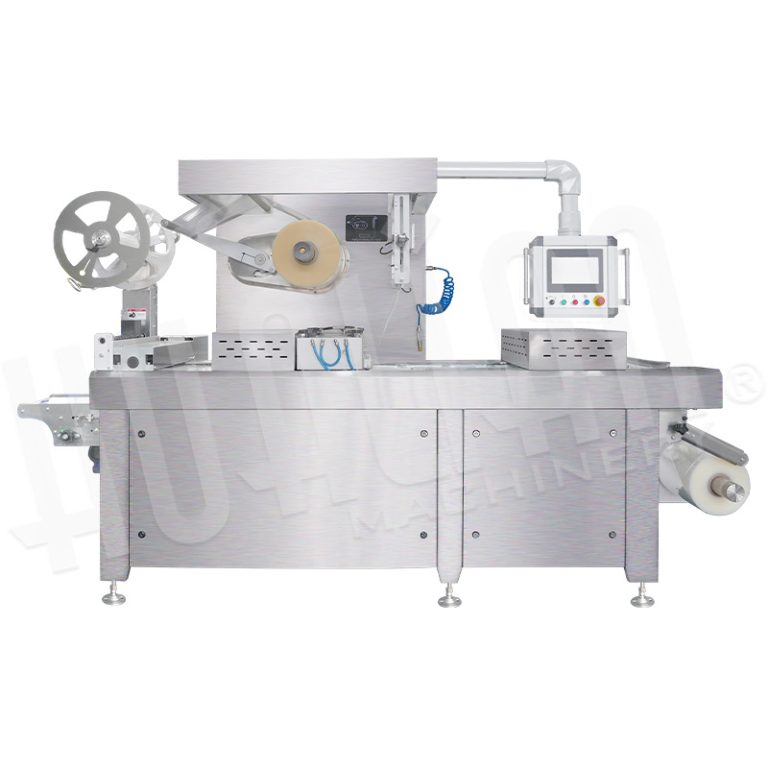
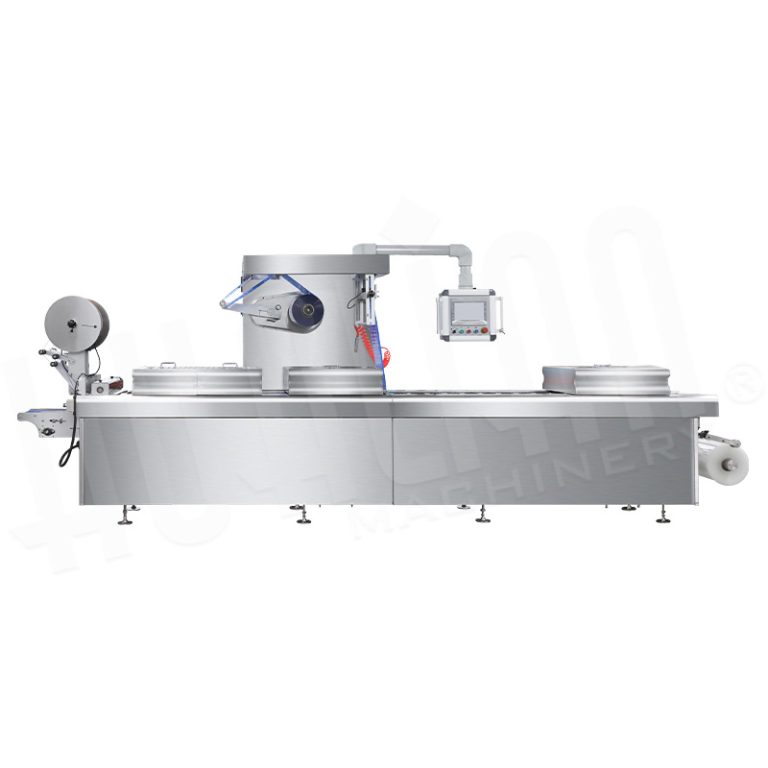
These machines may remove air, introduce inert gas, or combine vacuum and gas replacement before sealing. Hualian manufactures several types of Máquinas de embalagem a vácuo, but the correct process for coffee must be established by testing the actual product and package.
We do not recommend assuming that stronger vacuum automatically creates better coffee packaging. Freshly roasted coffee releases carbon dioxide, and vacuum can alter bag appearance or place additional demands on the pouch. Select the process together with the packaging material, degassing strategy, and shelf-life objective.
Máquinas de sachê e stick-pack
Sachet and stick-pack systems are commonly used for instant coffee, single-serve ground coffee, hotel portions, and samples. The appropriate filler depends on whether the product is a powder, granule, or blend. For multi-ingredient products, you should also consider segregation, dosing sequence, and cleaning between formulas.
Equipamentos secundários e de fim de linha
Your primary coffee package may be complete after sealing, but it may not be ready for distribution. A larger system can include checkweighing, metal detection, coding, labeling, case erection, case packing, carton sealing, palletizing, and stretch wrapping.
Review Hualian’s Soluções de linha de embalagem when your project extends beyond a standalone primary packaging machine.
Qual sistema de dosagem combina com o seu café?
Product behavior changes the dosing decision. Compare the dedicated coffee bean packaging machine buying guide Com o The ground coffee packaging machine buying guide for deeper application criteria.
| Dosing system | Typical coffee product | Main issue to verify | Suggested test |
|---|---|---|---|
| Balança Multihead | Feijão inteiro | Drop height and bean damage | Weight variation and breakage rate |
| Balança linear | Feijão inteiro | Stable cycle time | Continuous weight and speed trial |
| Auger filler | Chão de café | Density drift and dust | Multiple batches and hopper levels |
| Volumetric cup filler | Stable granules | Weight change as density changes | Batch-to-batch calibration |
Balançadores Multihead e Linear
A multihead weigher selects a combination of weigh buckets close to the target weight and is often used when you need higher throughput. A linear weigher uses one or more feed channels and can be a practical medium-speed option. With either system, evaluate not only accuracy but also bean damage and sustained output.
Mais Fillers
An auger filler uses a rotating screw to dispense ground coffee. It is widely used for powders, but identical auger revolutions do not guarantee identical weight if bulk density changes. Test different grinds, hopper levels, batches, and target weights. Dust extraction and control of the seal area should be included in the discussion.
Preenchimento de copo volumétrico
A cup filler dispenses a set volume rather than directly measuring weight. It can be economical for free-flowing products with stable density. If your coffee varies between batches, however, you may need frequent verification and recalibration.
Formatos de saco de café e compatibilidade de máquina
A pouch may look excellent on a shelf and still run poorly on an automatic line. For machine operation, evaluate the bag as a functional component.
| Bag characteristic | Por que isso importa |
|---|---|
| Mouth flatness | Affects pouch picking and opening |
| Width and length tolerance | Affects gripping, positioning, and sealing |
| Material stiffness | Affects feeding and handling stability |
| Surface friction | Affects movement through guides and belts |
| Zipper position | Affects opening and filling clearance |
| Valve position | May interfere with clamps or sealing components |
| Heat-seal layer | Determines temperature, pressure, and dwell time |
| Print registration | Affects cutting and artwork position on rollstock |
Do not approve a bag only from a visual mockup. Request production samples and test them on the proposed machine. For premade pouches, document dimensional tolerances. For rollstock, confirm film structure, thickness, roll diameter, core size, web width, and registration marks.

Como as máquinas de embalagem de café protegem a frescura
For system configuration, measurement and validation details, see our guide to nitrogen flushing systems for coffee packaging.
A packaging machine supports freshness, but it does not create shelf life by itself. The outcome depends on the coffee condition, barrier material, residual oxygen, seal integrity, degassing strategy, and storage conditions.
Nitrogênio Flush
Nitrogen flushing displaces oxygen before final sealing. High-purity nitrogen does not automatically produce low residual oxygen inside the pack. The gas must reach and displace air in the correct area, and the pouch must then be sealed without leakage.
Ask where nitrogen is introduced, how flow is controlled, how bag size affects flushing time, how much gas the line consumes, and how residual oxygen will be measured. Verify the finished package with a residual-oxygen analyzer instead of treating the presence of a gas inlet as proof of performance.
Válvulas de desgaseificação unidirecionais
A one-way valve allows carbon dioxide released by roasted coffee to leave while limiting oxygen entry. Nitrogen flushing and degassing valves perform different functions: nitrogen manages the initial package atmosphere, while the valve manages gas released after packaging.
A valve cannot correct a leaking heat seal, and nitrogen flushing does not remove the need for a degassing strategy in every application.
Embalagem a vácuo
Vacuum removes air before sealing but can create a compact pack and place pressure on beans and film. Its suitability depends on the coffee, time since roasting, pouch structure, desired appearance, and distribution conditions. Compare vacuum, gas flushing, and combined processes with actual samples.
Seal Integridade
Common causes of seal failure include coffee in the seal area, incorrect temperature, insufficient pressure or dwell time, worn components, wrinkles, and incompatible materials. If your current line has intermittent failures, use a structured method to troubleshoot inconsistent food package seals instead of changing several settings at once.
Máquinas de embalagem de café semi-automáticas vs. automáticas
Automation should follow your operating model. Review coffee packaging machines for small businesses or the requirements for high-volume coffee packaging production.
| Fator | Semi-automático | Automático |
|---|---|---|
| Investimento inicial | Mais baixo | Mais alto |
| Operator involvement | Mais alto | Lower, but not zero |
| Output consistency | More operator-dependent | More repeatable when the complete line is balanced |
| Short-run flexibility | Often high | Depends on tooling and changeover design |
| Integração | Limited | Greater |
| Maintenance requirements | Generally lower | Mais alto |
The correct automation level does not depend only on company size. A small company with one high-volume SKU may benefit from automation, while a large company may use a semi-automatic cell for short promotional runs. Decide using required output, labor availability, SKU count, batch length, changeover frequency, factory utilities, and maintenance capability.
Como calcular a capacidade que você precisa
Begin with required saleable production rather than advertised speed:
Required bags per minute = Target saleable bags per shift ÷ Available production minutes ÷ Expected line efficiency
If you need 12,000 acceptable bags in 420 production minutes and expect 75% overall efficiency, the calculation is:
12,000 ÷ 420 ÷ 0.75 = approximately 38 bags per minute
A machine rated at 30 bags per minute cannot meet that target. A machine advertised at 40 bags per minute may also provide too little margin once minor stops and changeovers are included.
Check every connected process: feeding, dosing, bag handling, gas flushing, sealing, coding, inspection, and case packing. The slowest reliable process determines line output. Our recommendation is to ask for a stable output range under stated conditions, not only a maximum cycle rate.
Quanto custa uma máquina de embalagem de café?
Use o dedicado coffee packaging machine cost guide to compare equipment scope, installed project cost and total cost of ownership.
Coffee packaging equipment has no single meaningful price because a project may be a standalone sealer, semi-automatic work cell, automatic primary packaging line, or complete line with inspection and palletizing.
Main cost factors include:
- Automation level and target speed
- Dosing technology
- Pouch or rollstock format
- Nitrogen flushing or vacuum functions
- Coding, labeling, and inspection
- Custom tooling and conveyors
- Electrical and control components
- Installation, training, and spare parts
Machine price is not the same as installed project cost or total cost of ownership. Your total may also include freight, duties, utilities, nitrogen, packaging material, operators, product giveaway, maintenance, changeover time, downtime, and rejected packs.
A lower purchase price can become the more expensive option if the machine overfills every bag, requires excessive labor, or stops frequently.
Lista de verificação de seleção de máquina de embalagem de café
For a complete decision sequence based on product, bag, weight, output and automation, follow our guide on how to choose a coffee packaging machine.
Café Informação
- Whole bean, ground, or instant coffee
- Roast level, grind size, and bulk density
- Product temperature and dust level
- Time between roasting and packaging
- Number of products and formulas
Pacote de informações
- Bag style, width, and length
- Target fill weight
- Material structure and thickness
- Zipper and valve position
- Printed registration marks
- Required seal appearance
Produção e informações de fábrica
- Target bags per shift and available production hours
- SKU count and changeover frequency
- Current staffing and future output target
- Available floor space and ceiling height
- Electrical supply, compressed air, and nitrogen source
- Existing upstream and downstream equipment
O que deve ser testado antes de comprar?
If you need to understand where each test result originates, review the step-by-step explanation of how a coffee packaging machine works.
Use your actual coffee and production packaging wherever practical. Substitute materials may support preliminary setup, but they cannot prove performance with your application.
| Test metric | What it tells you |
|---|---|
| Sacos estáveis por minuto | Realistic production speed |
| Average fill weight | Whether dosing is centered on target |
| Weight variation | Dosing repeatability |
| Product giveaway | The cost of overfilling |
| Seal-defect rate | Packaging integrity |
| Oxigênio residual | Gas-flushing performance |
| Bag-reject rate | Packaging-material compatibility |
| Mudança de tempo | Multi-SKU flexibility |
| Operator interventions | The real automation level |
Do not rely only on a short video showing a few successful bags. For a larger project, define the factory acceptance test before placing the order. Both sides should agree on materials, run conditions, test duration, permitted interventions, and the definition of an acceptable pack.

De uma máquina autônoma a uma linha completa de embalagem de café
Início Embalagem
Semi-automatic weighing → manual pouch placement → continuous band sealing → date coding
Linha de embalagem primária automática
Product feeding → dosing → pouch opening or bag forming → filling → nitrogen flushing → sealing → coding → checkweighing
Linha totalmente automatizada
Primary packaging → inspection and rejection → bag orientation → case erection → case packing → case sealing → palletizing → stretch wrapping
You do not need to automate everything at once. Begin with the constraint that limits output or quality. When planning a connected line, define accumulation, fault logic, reject handling, cleaning access, maintenance space, and future expansion. Connecting individually capable machines does not automatically create a reliable system; the interfaces must also be engineered.
Como avaliar um fornecedor de máquina de embalagem de café
A supplier should do more than confirm that a machine is “suitable for coffee.” Evaluate application understanding, testing, documentation, installation, training, spare parts, and service.
Peça evidências de aplicação
- Which coffee format has been tested?
- Which pouch or film was used?
- Was the stated speed sustained or momentary?
- How were weight, sealing, and residual oxygen evaluated?
- Which conditions were not tested?
Confirme a documentação e o suporte
Ask for the layout, utility requirements, operating manual, maintenance schedule, parts list, training scope, warranty terms, and response process. Review Hualian’s available customer service and support when evaluating how installation, training, and technical assistance will be handled.
Hualian Machinery Group was established in 1989 and manufactures more than 200 packaging-machine types across multiple categories. Company scale does not by itself prove application fit, so we still recommend matching the proposal to your product and verifying it through testing and agreed acceptance criteria.
Conclusão
The best coffee packaging machine is not automatically the fastest or most expensive model. It is the system that reliably produces your required package at the required quality and usable output.
Before selecting equipment, define the coffee format, package, fill weight, saleable output, freshness requirement, SKU schedule, automation boundary, and downstream process. Then test your actual coffee and packaging material.
If you are planning a project, prepare your coffee type, fill weight, bag dimensions, production target, utility information, and packaging samples. This gives Hualian’s engineering team enough information to evaluate whether a standalone machine, semi-automatic cell, or integrated packaging line is the appropriate starting point.
Perguntas frequentes
Qual é a melhor máquina para embalar grãos de café?
The best machine depends on bag style, fill weight, required output, and automation level. Whole beans are commonly dosed with a multihead, linear, or net weigh system. Test bean damage, weight variation, bag handling, and sealing before selecting the final configuration.
Qual máquina é usada para embalagem de café moído?
Ground coffee is commonly dosed with an auger filler integrated with a pouch-filling or form-fill-seal machine. Grind size, bulk density, and dust affect consistency, so the system should be tested with your product.
Uma máquina pode empacotar grãos de café e café moído?
The same main bagging machine may handle both, but you will usually need different dosing systems. You must also account for cleaning, dust control, changeover time, and cross-contamination.
Sacos de café precisam de nitrogênio?
Not every coffee product needs the same process. The answer depends on the coffee condition, packaging barrier, distribution period, and shelf-life target. If nitrogen is used, define and verify the required residual-oxygen result.
Uma válvula de desgaseificação ainda é necessária após a descarga de nitrogênio?
Nitrogen flushing displaces oxygen during packaging, while a one-way valve manages carbon dioxide released afterward. Whether you need both depends on roast conditions, resting time, package design, and distribution requirements.
Qual é a diferença entre o VFFS e a embalagem de embalagem pré-fabricada?
VFFS forms bags from rollstock film, fills them, and seals them. A premade-pouch machine fills bags manufactured beforehand. Compare material cost, bag appearance, output, flexibility, and pouch consistency.
Quanto custa uma máquina de embalagem de café?
Cost depends on scope. A standalone sealer, semi-automatic cell, automatic bagging machine, and complete line are different investments. Provide product, package, output, gas-flushing, inspection, and downstream requirements for a meaningful quotation.
Como calcular a velocidade de embalagem necessária?
Divide target saleable bags per shift by available production minutes, then divide by expected line efficiency. Confirm that every connected machine can sustain the resulting rate.
Quais informações você deve enviar para um fabricante de máquinas de embalagem de café?
Send the coffee type, roast or grind information, fill weight, bag style and dimensions, packaging specification, target output, utilities, gas-flushing requirements, existing equipment, and photos or physical samples.