Zum Inhalt wechseln
Choosing a coffee packaging machine is not simply a matter of finding equipment that can fill and seal a bag. You are selecting a production system that will affect fill-weight consistency, coffee freshness, package appearance, labor requirements, and your ability to increase output in the future.
Our view is straightforward: you should not select the machine first. Start by defining the coffee you need to package, the finished package you want to sell, the usable output your factory must achieve, and the point at which automation should begin and end. Only then can you compare dosing systems, bagging machines, sealers, nitrogen-flushing options, and downstream equipment.
Quick answer: Match the machine to four requirements: coffee format, finished package, usable production output, and automation scope. Whole beans normally use a weighing system, while ground coffee commonly uses an auger filler. You should also verify bag compatibility, seal quality, residual oxygen, changeover time, and sustained output with your actual product and packaging material.
What Is a Coffee Packaging Machine?
A coffee packaging machine is industrial equipment used to measure, fill, and close packages containing whole coffee beans, ground coffee, or instant coffee. Depending on the automation level, a system may handle product feeding, weighing or dosing, bag forming or opening, filling, nitrogen flushing, sealing, coding, inspection, case packing, and palletizing.
A small roastery might only need an automatic weighing unit and a Kontinuierliche Beutelverschließmaschine. A larger coffee factory may need a connected line that moves from product feeding and weighing through inspection, case packing, and palletizing.
Coffee packaging machines are not coffee makers
A coffee maker or espresso machine prepares a beverage. A coffee roaster develops the flavor of green beans, and a grinder reduces roasted beans to a selected particle size. An industrial coffee packaging machine begins its work after roasting and, where applicable, grinding. Its job is to place the coffee into a protective, saleable package with the required weight, appearance, and shelf-life performance.
Explore the Coffee Packaging Topic Cluster
Use these focused guides to move from basic equipment understanding to a shortlist that fits your coffee, package, output, and investment scope.
Understand the equipment
Choose by product and production scale
- How to choose a coffee packaging machine
- Coffee bean packaging machine buying guide
- Ground coffee packaging machine buying guide
- Coffee packaging machines for small businesses
- Coffee packaging machines for high-volume production
Plan preservation and investment
Define Four Requirements Before Comparing Machines
Many buyers begin by comparing machine speeds and prices. We believe that puts the decision in the wrong order. Start with the product and the finished pack; the machine must follow those requirements.
1. What type of coffee are you packaging?
| Coffee product | Main packaging challenges | Common dosing approach |
|---|---|---|
| Whole coffee beans | Irregular shape, breakage, oil, and degassing | Multihead, linear, or net weigh filling |
| Ground coffee | Dust, density changes, and product in the seal area | Auger filling |
| Instant coffee granules | Moisture sensitivity and particle damage | Weighing or volumetric dosing |
| Instant coffee powder | Dust, moisture sensitivity, and variable flow | Auger filling |
Whole beans are normally treated as a granular product, but transfer height and handling still matter because aggressive movement can damage them. Ground coffee behaves differently: its dosing performance depends on grind size, bulk density, moisture, and entrapped air. A setting that works for one grind may not produce the same weight with another.
This is why a claim such as “suitable for coffee” is not enough. You should ask which coffee format was tested and under what conditions.
2. What finished package do you need?
Common formats include pillow bags, side-gusset bags, flat-bottom bags, stand-up pouches, premade zipper pouches, sachets, stick packs, bulk bags, cans, and jars.
If you already use a printed premade pouch with a zipper and one-way degassing valve, the machine must pick, open, position, fill, and seal that specific pouch reliably. If you want to form bags from rollstock, the film structure, roll dimensions, registration marks, and required bag geometry become part of the machine specification.
3. What usable production output do you need?
Do not define output only as bags per minute. Provide target bags per shift, fill weight, available production minutes, SKU count, changeovers per day, current staffing, and expected growth.
A stated maximum speed is not the same as saleable output. Production time is lost during material replenishment, changeovers, cleaning, weight corrections, fault recovery, and downstream stoppages. A lower-speed machine that runs consistently may deliver more acceptable packages than a faster machine that frequently stops.
4. Where should automation begin and end?
“Automatic coffee packaging machine” can describe very different scopes. One quotation may cover a bagger only, while another includes dosing, nitrogen flushing, coding, inspection, and discharge. Define whether you need dosing only, filling and sealing, automatic primary packaging, inspection, case packing, or a complete line through palletizing.

Main Types of Coffee Packaging Machines
Start with our application-led comparison of coffee packaging machine types if you need to identify the correct machine family before reviewing individual models.
Semi-automatic weighing and filling machines
A semi-automatic system measures the coffee while an operator positions the pouch, activates the fill cycle, or moves the filled bag to a sealer. It can suit a growing roastery that produces many SKUs in smaller batches and wants better weight consistency without committing to a fully automatic line.
Evaluate the complete working cycle. If dosing takes three seconds but manual handling and sealing take another twelve seconds, the filler is not the production bottleneck.
Kontinuierliche Bandversiegelung
A continuous band sealer is useful when coffee is already inside a heat-sealable bag and you need more consistent closing than a hand or foot sealer provides. Depending on its configuration, the system may also support coding, air extraction, or gas flushing.
Hualian offers a range of industrial sealing machines for different bag sizes and production arrangements. Before choosing one, confirm bag material, thickness, seal width, filled weight, conveyor orientation, zipper and valve position, and whether gas flushing or coding is required.
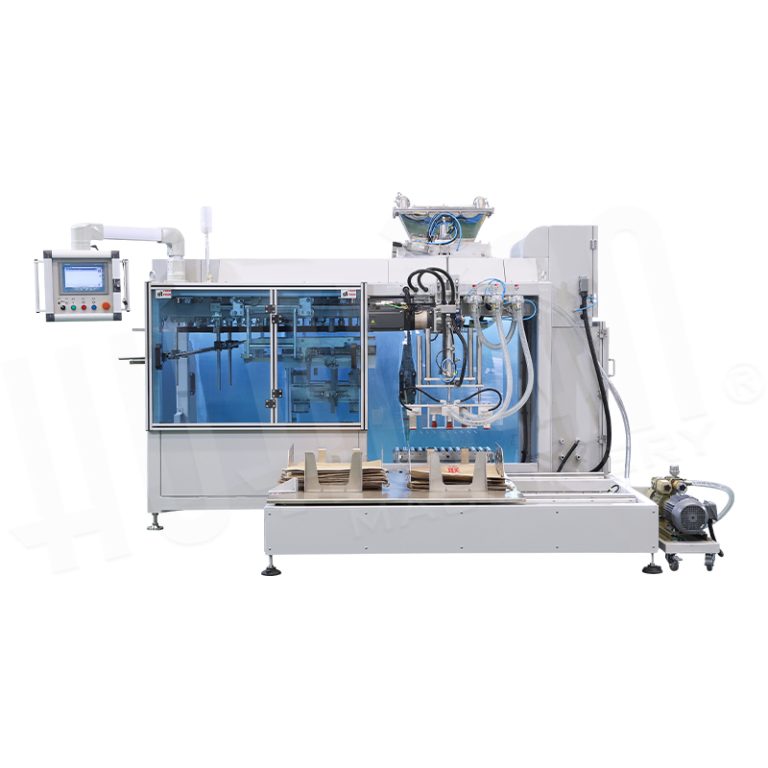
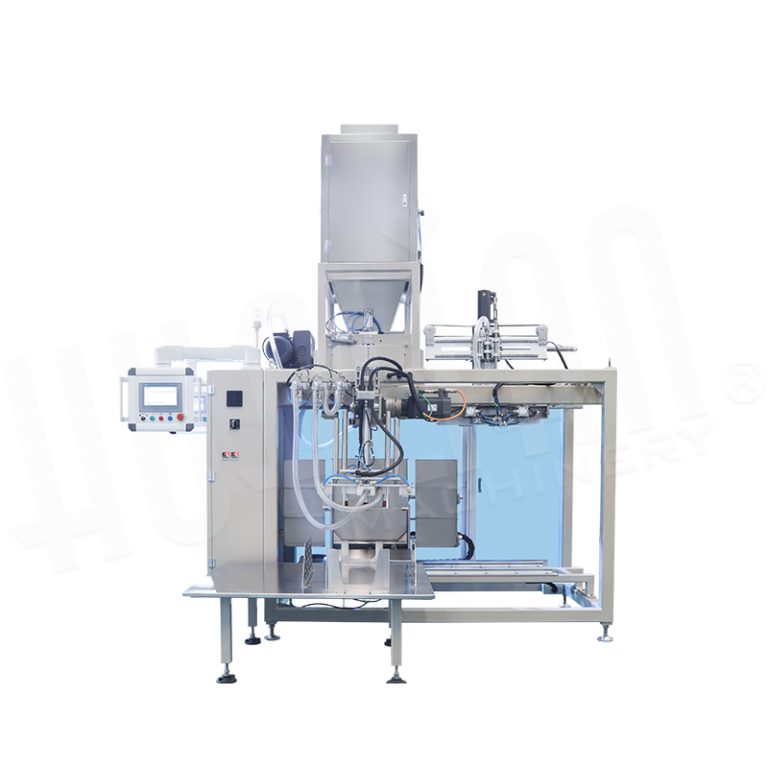
Premade pouch filling and sealing machines
A premade pouch machine typically picks, detects, opens, fills, flushes, seals, and discharges an existing bag. This route is popular for premium pouches, zippers, flat-bottom formats, and bags with pre-applied degassing valves.
The pouch must be treated as a machine component. Variation in dimensions, mouth flatness, stiffness, or surface friction can cause failed pickup, incomplete opening, crooked filling, or poor sealing. Always test your intended production pouches rather than relying only on a generic sample.
Vertical form-fill-seal machines
A vertical form-fill-seal machine unwinds rollstock, guides it around a forming collar, creates a tube, makes the longitudinal and bottom seals, receives a measured dose, closes the top, and cuts the finished bag.
VFFS equipment can support continuous production and may reduce packaging-material cost. It is usually most attractive when formats and production volumes are stable. It also requires suitable film, adequate factory height, and trained operators for film setup and changeover.
Vacuum and gas-flushing sealers
These machines may remove air, introduce inert gas, or combine vacuum and gas replacement before sealing. Hualian manufactures several types of Vakuumverpackungsmaschinen, but the correct process for coffee must be established by testing the actual product and package.
We do not recommend assuming that stronger vacuum automatically creates better coffee packaging. Freshly roasted coffee releases carbon dioxide, and vacuum can alter bag appearance or place additional demands on the pouch. Select the process together with the packaging material, degassing strategy, and shelf-life objective.
Sachet and stick-pack machines
Sachet and stick-pack systems are commonly used for instant coffee, single-serve ground coffee, hotel portions, and samples. The appropriate filler depends on whether the product is a powder, granule, or blend. For multi-ingredient products, you should also consider segregation, dosing sequence, and cleaning between formulas.
Secondary and end-of-line equipment
Your primary coffee package may be complete after sealing, but it may not be ready for distribution. A larger system can include checkweighing, metal detection, coding, labeling, case erection, case packing, carton sealing, palletizing, and stretch wrapping.
Review Hualian’s packaging line solutions when your project extends beyond a standalone primary packaging machine.
Which Dosing System Fits Your Coffee?
Product behavior changes the dosing decision. Compare the dedicated coffee bean packaging machine buying guide with the ground coffee packaging machine buying guide for deeper application criteria.
| Dosing system | Typical coffee product | Main issue to verify | Suggested test |
|---|---|---|---|
| Multihead weigher | Whole beans | Drop height and bean damage | Weight variation and breakage rate |
| Linear weigher | Whole beans | Stable cycle time | Continuous weight and speed trial |
| Auger filler | Ground coffee | Density drift and dust | Multiple batches and hopper levels |
| Volumetric cup filler | Stable granules | Weight change as density changes | Batch-to-batch calibration |
Multihead and linear weighers
A multihead weigher selects a combination of weigh buckets close to the target weight and is often used when you need higher throughput. A linear weigher uses one or more feed channels and can be a practical medium-speed option. With either system, evaluate not only accuracy but also bean damage and sustained output.
Auger fillers
An auger filler uses a rotating screw to dispense ground coffee. It is widely used for powders, but identical auger revolutions do not guarantee identical weight if bulk density changes. Test different grinds, hopper levels, batches, and target weights. Dust extraction and control of the seal area should be included in the discussion.
Volumetric cup fillers
A cup filler dispenses a set volume rather than directly measuring weight. It can be economical for free-flowing products with stable density. If your coffee varies between batches, however, you may need frequent verification and recalibration.
Coffee Bag Formats and Machine Compatibility
A pouch may look excellent on a shelf and still run poorly on an automatic line. For machine operation, evaluate the bag as a functional component.
| Bag characteristic | Why it matters |
|---|---|
| Mouth flatness | Affects pouch picking and opening |
| Width and length tolerance | Affects gripping, positioning, and sealing |
| Material stiffness | Affects feeding and handling stability |
| Surface friction | Affects movement through guides and belts |
| Zipper position | Affects opening and filling clearance |
| Valve position | May interfere with clamps or sealing components |
| Heat-seal layer | Determines temperature, pressure, and dwell time |
| Print registration | Affects cutting and artwork position on rollstock |
Do not approve a bag only from a visual mockup. Request production samples and test them on the proposed machine. For premade pouches, document dimensional tolerances. For rollstock, confirm film structure, thickness, roll diameter, core size, web width, and registration marks.

How Coffee Packaging Machines Protect Freshness
For system configuration, measurement and validation details, see our guide to nitrogen flushing systems for coffee packaging.
A packaging machine supports freshness, but it does not create shelf life by itself. The outcome depends on the coffee condition, barrier material, residual oxygen, seal integrity, degassing strategy, and storage conditions.
Nitrogen flushing
Nitrogen flushing displaces oxygen before final sealing. High-purity nitrogen does not automatically produce low residual oxygen inside the pack. The gas must reach and displace air in the correct area, and the pouch must then be sealed without leakage.
Ask where nitrogen is introduced, how flow is controlled, how bag size affects flushing time, how much gas the line consumes, and how residual oxygen will be measured. Verify the finished package with a residual-oxygen analyzer instead of treating the presence of a gas inlet as proof of performance.
One-way degassing valves
A one-way valve allows carbon dioxide released by roasted coffee to leave while limiting oxygen entry. Nitrogen flushing and degassing valves perform different functions: nitrogen manages the initial package atmosphere, while the valve manages gas released after packaging.
A valve cannot correct a leaking heat seal, and nitrogen flushing does not remove the need for a degassing strategy in every application.
Vakuumverpackung
Vacuum removes air before sealing but can create a compact pack and place pressure on beans and film. Its suitability depends on the coffee, time since roasting, pouch structure, desired appearance, and distribution conditions. Compare vacuum, gas flushing, and combined processes with actual samples.
Seal integrity
Common causes of seal failure include coffee in the seal area, incorrect temperature, insufficient pressure or dwell time, worn components, wrinkles, and incompatible materials. If your current line has intermittent failures, use a structured method to troubleshoot inconsistent food package seals instead of changing several settings at once.
Semi-Automatic vs. Automatic Coffee Packaging Machines
Automation should follow your operating model. Review coffee packaging machines for small businesses or the requirements for high-volume coffee packaging production.
| Faktor | Halbautomatisch | Automatisch |
|---|---|---|
| Erstinvestition | Lower | Higher |
| Operator involvement | Higher | Lower, but not zero |
| Output consistency | More operator-dependent | More repeatable when the complete line is balanced |
| Short-run flexibility | Often high | Depends on tooling and changeover design |
| Integration | Limited | Greater |
| Maintenance requirements | Generally lower | Higher |
The correct automation level does not depend only on company size. A small company with one high-volume SKU may benefit from automation, while a large company may use a semi-automatic cell for short promotional runs. Decide using required output, labor availability, SKU count, batch length, changeover frequency, factory utilities, and maintenance capability.
How to Calculate the Capacity You Need
Begin with required saleable production rather than advertised speed:
Required bags per minute = Target saleable bags per shift ÷ Available production minutes ÷ Expected line efficiency
If you need 12,000 acceptable bags in 420 production minutes and expect 75% overall efficiency, the calculation is:
12,000 ÷ 420 ÷ 0.75 = approximately 38 bags per minute
A machine rated at 30 bags per minute cannot meet that target. A machine advertised at 40 bags per minute may also provide too little margin once minor stops and changeovers are included.
Check every connected process: feeding, dosing, bag handling, gas flushing, sealing, coding, inspection, and case packing. The slowest reliable process determines line output. Our recommendation is to ask for a stable output range under stated conditions, not only a maximum cycle rate.
How Much Does a Coffee Packaging Machine Cost?
Use the dedicated coffee packaging machine cost guide to compare equipment scope, installed project cost and total cost of ownership.
Coffee packaging equipment has no single meaningful price because a project may be a standalone sealer, semi-automatic work cell, automatic primary packaging line, or complete line with inspection and palletizing.
Main cost factors include:
- Automation level and target speed
- Dosing technology
- Pouch or rollstock format
- Nitrogen flushing or vacuum functions
- Coding, labeling, and inspection
- Custom tooling and conveyors
- Electrical and control components
- Installation, training, and spare parts
Machine price is not the same as installed project cost or total cost of ownership. Your total may also include freight, duties, utilities, nitrogen, packaging material, operators, product giveaway, maintenance, changeover time, downtime, and rejected packs.
A lower purchase price can become the more expensive option if the machine overfills every bag, requires excessive labor, or stops frequently.
Coffee Packaging Machine Selection Checklist
For a complete decision sequence based on product, bag, weight, output and automation, follow our guide on how to choose a coffee packaging machine.
Coffee information
- Whole bean, ground, or instant coffee
- Roast level, grind size, and bulk density
- Product temperature and dust level
- Time between roasting and packaging
- Number of products and formulas
Package information
- Bag style, width, and length
- Target fill weight
- Material structure and thickness
- Zipper and valve position
- Printed registration marks
- Required seal appearance
Production and factory information
- Target bags per shift and available production hours
- SKU count and changeover frequency
- Current staffing and future output target
- Available floor space and ceiling height
- Electrical supply, compressed air, and nitrogen source
- Existing upstream and downstream equipment
What Should Be Tested Before You Buy?
If you need to understand where each test result originates, review the step-by-step explanation of how a coffee packaging machine works.
Use your actual coffee and production packaging wherever practical. Substitute materials may support preliminary setup, but they cannot prove performance with your application.
| Test metric | What it tells you |
|---|---|
| Stable bags per minute | Realistic production speed |
| Average fill weight | Whether dosing is centered on target |
| Weight variation | Dosing repeatability |
| Product giveaway | The cost of overfilling |
| Seal-defect rate | Packaging integrity |
| Residual oxygen | Gas-flushing performance |
| Bag-reject rate | Packaging-material compatibility |
| Changeover time | Multi-SKU flexibility |
| Operator interventions | The real automation level |
Do not rely only on a short video showing a few successful bags. For a larger project, define the factory acceptance test before placing the order. Both sides should agree on materials, run conditions, test duration, permitted interventions, and the definition of an acceptable pack.

From a Standalone Machine to a Complete Coffee Packaging Line
Starter packaging setup
Semi-automatic weighing → manual pouch placement → continuous band sealing → date coding
Automatic primary packaging line
Product feeding → dosing → pouch opening or bag forming → filling → nitrogen flushing → sealing → coding → checkweighing
Complete automated line
Primary packaging → inspection and rejection → bag orientation → case erection → case packing → case sealing → palletizing → stretch wrapping
You do not need to automate everything at once. Begin with the constraint that limits output or quality. When planning a connected line, define accumulation, fault logic, reject handling, cleaning access, maintenance space, and future expansion. Connecting individually capable machines does not automatically create a reliable system; the interfaces must also be engineered.
How to Evaluate a Coffee Packaging Machine Supplier
A supplier should do more than confirm that a machine is “suitable for coffee.” Evaluate application understanding, testing, documentation, installation, training, spare parts, and service.
Ask for application evidence
- Which coffee format has been tested?
- Which pouch or film was used?
- Was the stated speed sustained or momentary?
- How were weight, sealing, and residual oxygen evaluated?
- Which conditions were not tested?
Confirm documentation and support
Ask for the layout, utility requirements, operating manual, maintenance schedule, parts list, training scope, warranty terms, and response process. Review Hualian’s available customer service and support when evaluating how installation, training, and technical assistance will be handled.
Hualian Machinery Group was established in 1989 and manufactures more than 200 packaging-machine types across multiple categories. Company scale does not by itself prove application fit, so we still recommend matching the proposal to your product and verifying it through testing and agreed acceptance criteria.
Abschluss
The best coffee packaging machine is not automatically the fastest or most expensive model. It is the system that reliably produces your required package at the required quality and usable output.
Before selecting equipment, define the coffee format, package, fill weight, saleable output, freshness requirement, SKU schedule, automation boundary, and downstream process. Then test your actual coffee and packaging material.
If you are planning a project, prepare your coffee type, fill weight, bag dimensions, production target, utility information, and packaging samples. This gives Hualian’s engineering team enough information to evaluate whether a standalone machine, semi-automatic cell, or integrated packaging line is the appropriate starting point.
Frequently Asked Questions
What is the best machine for packaging coffee beans?
The best machine depends on bag style, fill weight, required output, and automation level. Whole beans are commonly dosed with a multihead, linear, or net weigh system. Test bean damage, weight variation, bag handling, and sealing before selecting the final configuration.
What machine is used for ground coffee packaging?
Ground coffee is commonly dosed with an auger filler integrated with a pouch-filling or form-fill-seal machine. Grind size, bulk density, and dust affect consistency, so the system should be tested with your product.
Can one machine package both coffee beans and ground coffee?
The same main bagging machine may handle both, but you will usually need different dosing systems. You must also account for cleaning, dust control, changeover time, and cross-contamination.
Do coffee bags need nitrogen flushing?
Not every coffee product needs the same process. The answer depends on the coffee condition, packaging barrier, distribution period, and shelf-life target. If nitrogen is used, define and verify the required residual-oxygen result.
Is a degassing valve still needed after nitrogen flushing?
Nitrogen flushing displaces oxygen during packaging, while a one-way valve manages carbon dioxide released afterward. Whether you need both depends on roast conditions, resting time, package design, and distribution requirements.
What is the difference between VFFS and premade-pouch packaging?
VFFS forms bags from rollstock film, fills them, and seals them. A premade-pouch machine fills bags manufactured beforehand. Compare material cost, bag appearance, output, flexibility, and pouch consistency.
How much does a coffee packaging machine cost?
Cost depends on scope. A standalone sealer, semi-automatic cell, automatic bagging machine, and complete line are different investments. Provide product, package, output, gas-flushing, inspection, and downstream requirements for a meaningful quotation.
How do you calculate the required packaging speed?
Divide target saleable bags per shift by available production minutes, then divide by expected line efficiency. Confirm that every connected machine can sustain the resulting rate.
What information should you send to a coffee packaging machine manufacturer?
Send the coffee type, roast or grind information, fill weight, bag style and dimensions, packaging specification, target output, utilities, gas-flushing requirements, existing equipment, and photos or physical samples.