跳到内容
跳到内容 
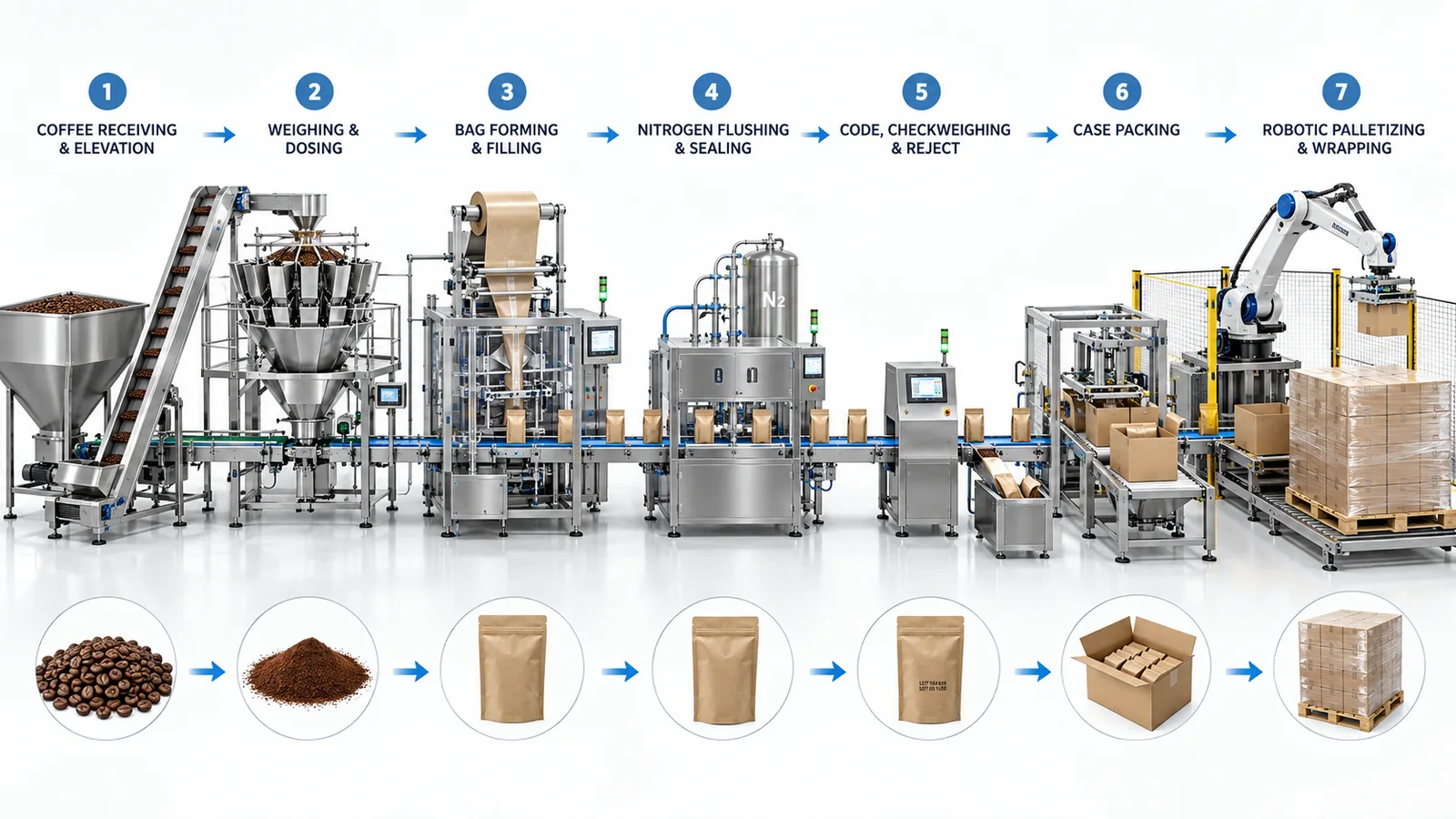
A reliable automated coffee bag line is designed backward from saleable cases or pallets, with every transfer, quality check, buffer and fault response defined.
Quick answer: Document products, bags, outputs, quality criteria and labor first. Then integrate coffee feeding, dosing, bag forming or pouch opening, filling, atmosphere control, sealing, coding, inspection, case packing and palletizing around the true bottleneck. Commission in stages and prove sustained output plus fault recovery.
This article supports our coffee packaging machine guide by focusing on one operational decision in greater depth.
1. Define the Automation Objective
- Saleable bags, cases or pallets per shift by SKU
- Whole bean or ground coffee condition and supply method
- Fill weights, bag styles, materials, zipper and valve configuration
- Residual oxygen, seal, weight, code and inspection criteria
- Available labor and tasks that create ergonomic or safety risk
- Changeover frequency, campaign size and future formats
- Layout, ceiling height, utilities and downstream warehouse interface
2. Map the Existing Process and Constraint
Measure time and loss at roasting discharge, resting or storage, grinding, transfer, weighing, bag preparation, filling, gas flushing, sealing, checking, case packing and palletizing. Separate work time from waiting and rework.
Automating a fast step does little if the line remains starved by coffee supply or blocked by case packing. Select the constraint that limits saleable output or quality, then model how the constraint may move after the first upgrade.
3. Choose the Primary Packaging Architecture
| Architecture | Choose when | Watch for |
|---|---|---|
| Semi-automatic filler and sealer | Lower volume, many SKUs, operator flexibility and staged investment matter | Labor balance, manual presentation and quality consistency |
| VFFS rollstock line | Rollstock economics and formed-bag output fit the package strategy | Film qualification, forming set, factory height and valve requirements |
| Premade-pouch line | Converted pouch appearance, zipper or format flexibility justify it | Pouch tolerance, opening reliability, magazine replenishment and unit cost |
| Rigid-container line | Cans, jars or other containers are the required commercial format | Container handling, closure, headspace and downstream conveyance |
4. Integrate Product Feeding and Dosing
For beans, control drops and transfers to limit damage while maintaining stable weigher supply. For grounds, address dust, compaction, static and density variation in conveyors, hoppers and augers. Level sensors should coordinate replenishment without surging the dosing system.
Define what happens to coffee in transit when the bagger stops. Uncontrolled accumulation can change density, damage beans or create a dusty restart.
5. Add Atmosphere Control, Sealing and Coding
Place nitrogen delivery or vacuum functions where the package geometry and cycle permit effective atmosphere control. Define residual-oxygen testing instead of specifying only source-gas purity. Coordinate filling, settling, purge and sealing time.
Coder selection depends on package material, print area, line speed and traceability. The code trigger and recipe must remain synchronized through stops and rejects.
6. Automate Inspection and Rejection
| Quality risk | Possible control | Integration requirement |
|---|---|---|
| Incorrect weight | Checkweigher with reject | Product spacing, recipe, reject confirmation and containment |
| Contaminant risk | Appropriate detector selected through hazard assessment | Test pieces, package effect and locked reject handling |
| Missing or wrong code | Vision or code reader | Readable location, lighting, data and line stop/reject policy |
| Seal or appearance defect | Vision or offline sample method | Defined defect library and false-reject management |
| High residual oxygen | Sampling or inline analyzer where justified | Calibration, sample timing, response and record |
7. Design Secondary Packaging and Palletizing
Case erection, robotic or conventional case packing, case sealing, labeling, checkweighing, palletizing and stretch wrapping must match the bagger’s delivery orientation and actual rate. Define case and pallet patterns for every SKU.
Allow safe manual fallback only where it is planned, staffed and guarded. A bypass that was never engineered can become a recurring safety and traceability risk.
8. Engineer Accumulation and Line Controls
Machines should exchange ready, run, starved, blocked, fault and safe-state information. Accumulation can absorb short stops, but only if held packages are not crushed, overheated, mixed or deprived of traceability.
Define controlled stopping and restart for low product, missing pouch, film splice, gas loss, checkweigher reject, case shortage, full pallet and emergency stop. Recovery logic determines whether the line produces good packs after disturbance.
9. Plan Changeovers and Material Replenishment
- Group SKUs by coffee, weight, bag width, material, valve, case and pallet pattern.
- Separate recipe changes from mechanical change parts and cleaning requirements.
- Define line clearance, material identification and first-good-pack approval.
- Provide safe access for coffee, film, pouches, labels, cases, pallets and rejects.
- Measure replenishment and changeover losses in the capacity model.
10. Assign One Integration Owner
State who owns layout, controls, safety, interfaces, performance, documentation, FAT, installation and SAT when equipment comes from multiple suppliers. A capable weigher, bagger and case packer can still form an unreliable system if no party owns the handshakes and end-to-end result.
For larger projects, compare this plan with the high-volume coffee packaging line requirements. For machine selection, use the coffee packaging machine selection framework.
Commission in Controlled Stages
| Stage | Primary proof |
|---|---|
| Component test | Each machine performs its function with approved materials |
| Dry interface test | Signals, states, guarding and controlled stop/restart work |
| Product trial | Coffee flows, doses, fills and seals without unacceptable damage or contamination |
| Quality validation | Weight, seal, code, atmosphere and reject results meet defined methods |
| Sustained FAT | End-to-end saleable output and recovery meet agreed conditions |
| Site SAT/ramp-up | Utilities, operators, upstream supply and downstream logistics work in the real plant |
Build the Business Case in Phases
Compare automation against labor, giveaway, packaging waste, rework, quality risk, downtime and growth—not labor alone. A staged project may start with dosing and sealing, then add automatic bag handling, inspection, cases and pallets when volume and process stability justify them.
Avoid automating an unstable process. Standardize coffee supply, package specifications, quality checks and changeovers first, or automation may reproduce variation faster.
Prepare for an Application Review
Send Hualian your coffee type, fill weights, package drawings and samples, target saleable output, SKU schedule, layout, utilities, inspection needs, and present production problems. The engineering team can then define a testable machine or line scope instead of relying on a generic configuration.
Frequently Asked Questions
What should you automate first in coffee bagging?
Automate the step that constrains saleable output, quality or safe labor after measuring the complete process.
Can one line pack beans and ground coffee?
Sometimes, but they normally require different dosing and dust-control arrangements plus validated changeovers and cleaning.
Do you need case packing and palletizing immediately?
Not always. They are justified when downstream labor or rate limits the primary line and the SKU pattern is stable enough.
How much accumulation should a line have?
Determine it from stop data, package tolerance, recovery strategy and the cost of floor space; there is no universal buffer time.
What belongs in a line FAT?
Representative SKUs, sustained output, quality metrics, material replenishment, rejects, changeovers, simulated faults and recovery should be defined.