Zum Inhalt wechseln
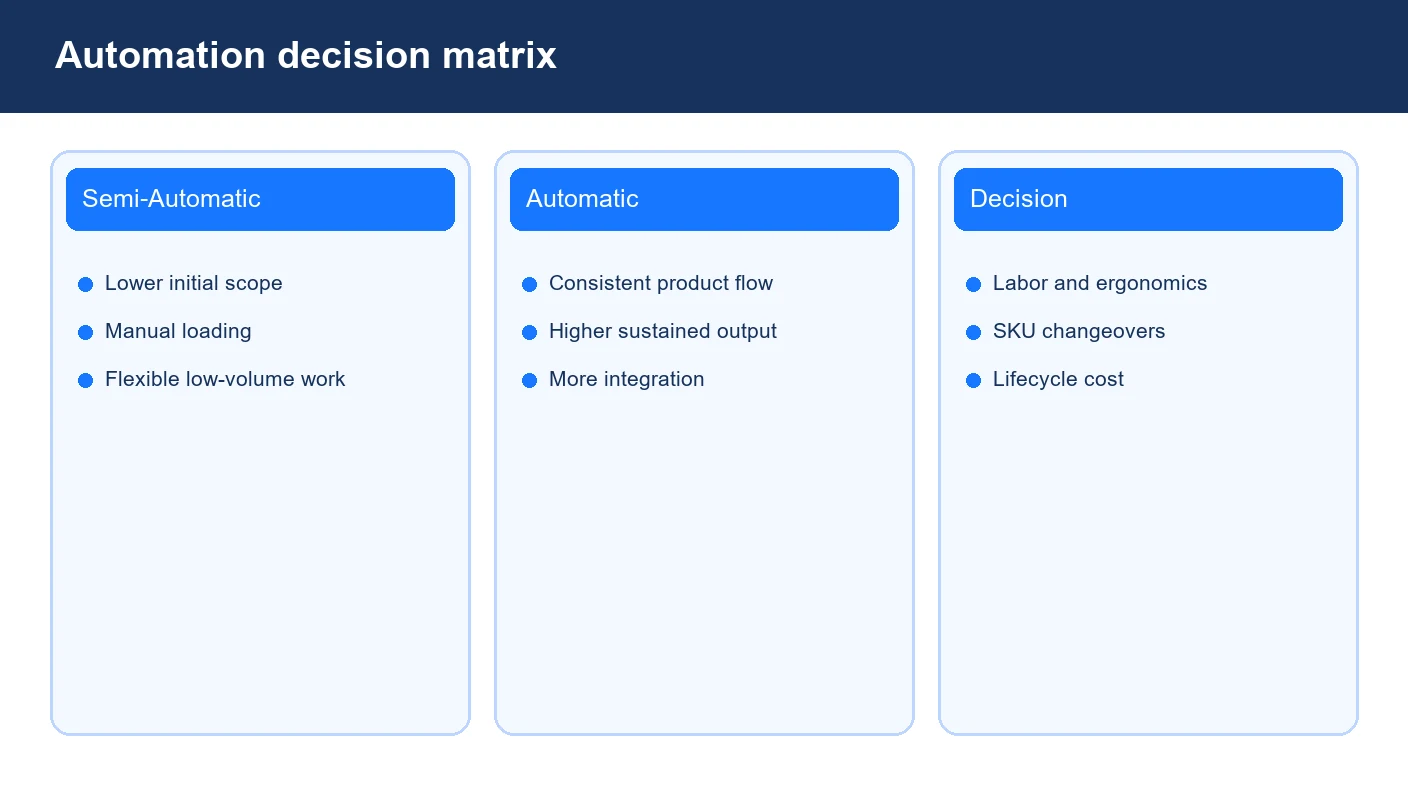
The right automation level is the lowest level that reliably meets the production requirement and supports future operation. Semi-automatic equipment retains defined operator tasks; automatic equipment transfers more handling and control to connected machinery. The decision should be based on the complete process, not the label attached to one machine.
Buyer focus: Use the article as a screening framework. Final equipment suitability must be confirmed with representative product, packaging material and acceptance criteria.
Semi-Automatic vs Automatic at a Glance
| Faktor | Halbautomatisch | Automatisch |
|---|---|---|
| Operator role | Loads, positions or transfers some items | Monitors a more connected sequence |
| Flexibilität | Can suit short runs and manual adjustments | Depends on formats, recipes and change parts |
| Integration | Fewer automatic interfaces | Requires coordinated infeed, discharge and controls |
| Investment basis | Lower equipment scope may be possible | Include conveyors, guarding, controls and commissioning |
Map Every Operator Task
Record who feeds product, presents containers, starts cycles, removes packs, inspects quality, replenishes material and clears faults. Automation only removes labor when the surrounding process can supply and receive product consistently.
Compare Output and Process Consistency
Calculate accepted output for the actual shift and SKU schedule. Automatic transfer can reduce repeated manual handling, but poor feeding, frequent stops or mismatched downstream capacity can prevent the system from reaching its intended rate.
Compare Flexibility and Changeover
Review the number of products, formats and daily changes. Ask which components, tools, recipes and adjustments change and what evidence is required for the first acceptable pack. For a broader method, see multi-SKU equipment planning.
Account for Space, Utilities and Controls
Automatic systems may need more conveyors, sensors, guarding, accumulation and service access. Confirm electrical supply, compressed air, extraction or gas requirements, data interfaces and safe access before layout approval.
Compare Costs Over the Intended Use
Include equipment, installation, training, staffing, materials, waste, maintenance, spare parts and downtime. Do not assume automation is automatically cheaper; use the total cost of ownership guide with plant-specific inputs.
Choose Semi-Automatic When It Fits
Semi-automatic equipment may be appropriate when demand is moderate, product presentation needs operator judgment, formats change frequently or the surrounding process remains manual. Verify ergonomics, staffing and the ability to maintain consistent package quality.
Choose Automatic When the Complete Line Supports It
Automatic equipment becomes more compelling when repeated handling is a bottleneck, supply is stable and downstream operations can accept the output. Define fault recovery, accumulation, operator coverage and controls integration before approval.
Document the Automation Decision
Record current and future demand, SKU mix, labor tasks, quality requirements, interfaces and financial assumptions. Return to the food packaging equipment buyer’s guide for the full selection workflow.
Evidence and standards to verify
Food equipment selection should reflect applicable hygiene and safety requirements. FDA CGMP guidance addresses cleanable food equipment; ISO 12100 provides machinery risk-assessment principles; and PMMI’s 2025 workforce study reports findings from 136 end-user and OEM respondents on skills, embedded guidance, remote support and targeted automation.
Frequently Asked Questions
Does automatic equipment require no operators?
No. Operators are still needed for supervision, replenishment, quality checks, cleaning, changeovers and fault response.
Is semi-automatic equipment only for small companies?
No. It can be appropriate for specialized products, short runs or processes where controlled manual handling remains useful.
Can a semi-automatic machine be upgraded later?
Sometimes, but upgrade scope depends on machine design, controls, guarding and interfaces. Confirm the pathway before purchase.
Is semi-automatic equipment only for small companies?
No. Large plants may use it for trials, seasonal products, rework, low-volume SKUs or processes that still require manual loading.
What often limits an automatic machine in practice?
Inconsistent upstream product supply, manual loading, downstream congestion, material variation and long changeovers can limit sustained output.
How should labor savings be calculated?
Compare the complete staffing pattern by shift, including feeding, loading, inspection, replenishment, changeover, cleaning and supervision.
Discuss a testable packaging requirement with HUALIAN
Send product details, package samples, target output, SKU range and factory conditions. Use the same written requirement when comparing suppliers.
Review Automatic Compact MAP Thermoforming Vacuum Packaging Machine
Related Resources
- How to Choose Food Packaging Equipment: A Practical Buyer’s Guide
- Food Packaging Equipment Hygienic Design Checklist
- Food Packaging Machine Factory Acceptance Test Checklist