Перейти к содержанию
A nitrogen flushing system displaces oxygen-rich air from a coffee package before sealing, but the gas nozzle alone does not prove that the process works.
Quick answer: Define the freshness objective, package and valve strategy, residual-oxygen target and measurement method first. Then engineer the gas source, regulation, delivery point, purge timing, sealing delay, monitoring, and acceptance test around the actual coffee, pack size, barrier material, and line speed.
This article goes deeper than our coffee packaging machine guide and focuses on one specific equipment decision.
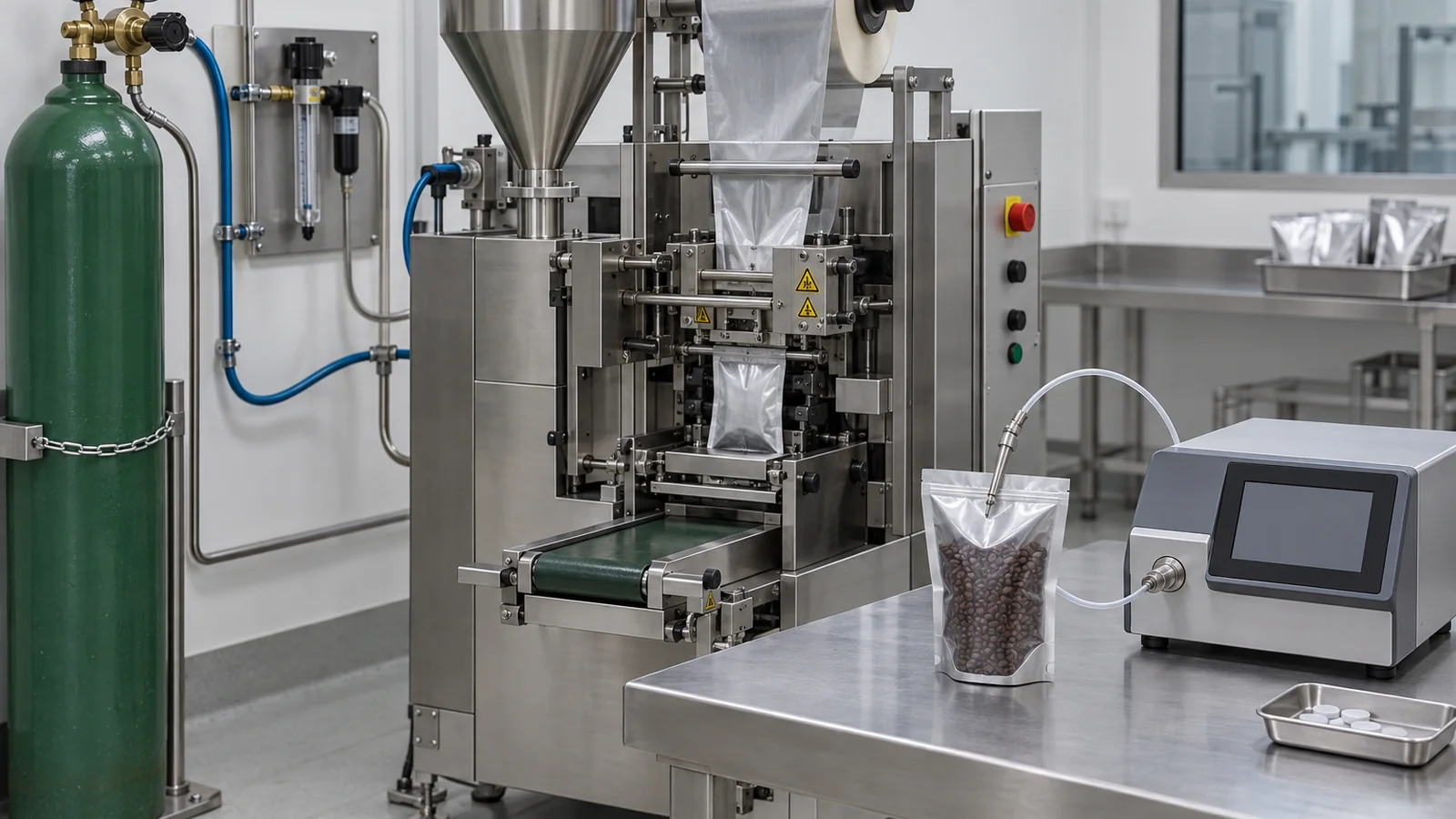
How Nitrogen Flushing Works
Nitrogen is introduced into the package or product path to replace part of the surrounding air before closure. The machine must deliver enough gas to the correct location, limit re-entry of air, and complete a sound seal. The finished-pack result matters more than gas purity at the source.
The Specialty Coffee Association discusses oxygen, moisture, temperature, time, vacuum, nitrogen flushing, and one-way valves in its review of coffee freshness.
The Main System Components
| Component | Function | Question to specify |
|---|---|---|
| Gas source | Supplies nitrogen | Cylinder, bulk supply, or generator; purity and capacity |
| Regulation and filtration | Controls usable supply | Pressure, cleanliness, alarms, and safe connection |
| Flow control | Sets gas delivery | Fixed, recipe-based, or feedback-controlled |
| Nozzle, lance, or purge path | Places gas in the package | Position relative to coffee, bag mouth, and seal |
| Bag handling and sealing | Limits air re-entry and closes package | Delay, motion, headspace, and sealing window |
| Analyzer | Measures residual oxygen | Sampling method, calibration, timing, and frequency |
Residual Oxygen Is the Process Output
Source-gas purity and package residual oxygen are different measurements. Air can remain in product voids or headspace, enter during transfer, or leak through a poor seal. Define where and when samples are taken and how the analyzer is calibrated.
Use enough samples to understand variation, not only the best result. Review startup, stable production, speed changes, bag-size changes, and the period after replenishment or stoppage.
What Controls the Result
- Coffee form, temperature, density, and time since roast
- Package volume, headspace, geometry, and barrier
- Gas purity, pressure, flow, position, and purge duration
- Fill sequence, settling, and time before sealing
- Line speed and changes in machine timing
- Seal cleanliness and integrity
- One-way valve design and position
- Storage and distribution conditions
Whole Beans and Grounds Behave Differently
Whole beans contain spaces through which gas can move, but recently roasted beans can continue to release carbon dioxide. Ground coffee has more exposed surface area and can retain air within a powder bed. Do not transfer a gas recipe between products or weights without verification.
Nitrogen Flushing and One-Way Valves
Nitrogen reduces oxygen-rich air at packing. A one-way valve allows gas released by coffee to exit while limiting inward flow under its design conditions. Whether you need one or both depends on the roast, resting time, package, distribution, and validation plan.
Confirm whether valves are purchased pre-applied, installed online, or handled in a separate process. Their location must not conflict with grippers, guides, forming, filling, or seals.
When Nitrogen Flushing May Not Be the First Investment
- Distribution is short and the shelf-life objective does not justify the system.
- The package has inadequate barrier or unreliable seals.
- Residual oxygen will not be measured.
- The line cannot control the delay between purge and sealing.
- Gas supply, ventilation, or safe operating procedures are not ready.
- A simpler operational improvement addresses the actual freshness or quality problem.
How to Set Up a Validation Trial
- Define coffee, roast/rest condition, weight, and package lot.
- Set gas purity, pressure, flow, nozzle position, timing, and line rate.
- Record seal parameters and valve configuration.
- Sample residual oxygen at defined locations and times.
- Inspect seal integrity and package appearance.
- Repeat across representative products, sizes, speeds, and starts/stops.
- Use shelf-life work to connect the package-atmosphere result to the commercial objective.
Nitrogen System FAT Checklist
| Check | Evidence |
|---|---|
| Supply capacity | Stable pressure and flow at production demand |
| Recipe control | Protected, repeatable settings for pack sizes |
| Finished-pack oxygen | Agreed sample count, method, timing, and result |
| Seal quality | No contamination or leakage under agreed inspection |
| Speed sensitivity | Result remains controlled across intended rate |
| Alarm response | Low supply or process fault produces defined action |
| Consumption | Measured or calculated under stated conditions |
Prepare the Information for an Application Review
Send Hualian your coffee type, fill weight, package drawings and samples, target saleable output, SKU schedule, utility information, and required inspection scope. These inputs allow the engineering team to define a testable configuration instead of assuming that a standard machine will fit.
Frequently Asked Questions
Does nitrogen flushing remove all oxygen?
No. It displaces oxygen-rich air, but residual oxygen depends on the complete process and package.
Is high-purity nitrogen the same as low residual oxygen?
No. Gas purity is an input; residual oxygen in the finished package is the process result.
Do nitrogen-flushed coffee bags need a valve?
Sometimes. The decision depends on coffee degassing, time after roasting, package design, and distribution.
How is residual oxygen measured?
A calibrated analyzer samples package headspace according to a defined method and timing.
Can nitrogen flushing fix a poor seal?
No. A leaking or contaminated seal can allow the package atmosphere to change after packing.
How much nitrogen does a line use?
Consumption depends on package volume, flow, purge method, speed, product, and target; measure it under stated conditions.