ข้ามไปที่เนื้อหา
Troubleshooting should protect people first, preserve evidence, and separate product, packaging material, machine, utility, and integration causes before settings are changed.
Quick answer: Define the defect, contain affected packs, record the current recipe and conditions, check what changed, and test one plausible cause at a time. Confirm the correction with a sustained run and measurable pack results—not merely by clearing the alarm.
This article supports our coffee packaging machine guide by focusing on one operational decision in greater depth.
Use a Safe, Repeatable Troubleshooting Sequence
- Stop and make the condition safe; isolate hazardous energy before entering guarded or heated areas.
- Contain product made since the last confirmed good check.
- Describe the symptom with samples, time, frequency, alarm history and affected SKU.
- Record coffee, bag or film lot, recipe, speed, temperature, pressure, gas and utility conditions.
- Ask what changed: product, material, operator, cleaning, maintenance, environment, upstream or downstream equipment.
- Separate product, package, machine, utility and line-interface hypotheses.
- Change one factor within approved limits, then verify with an agreed sample and sustained run.
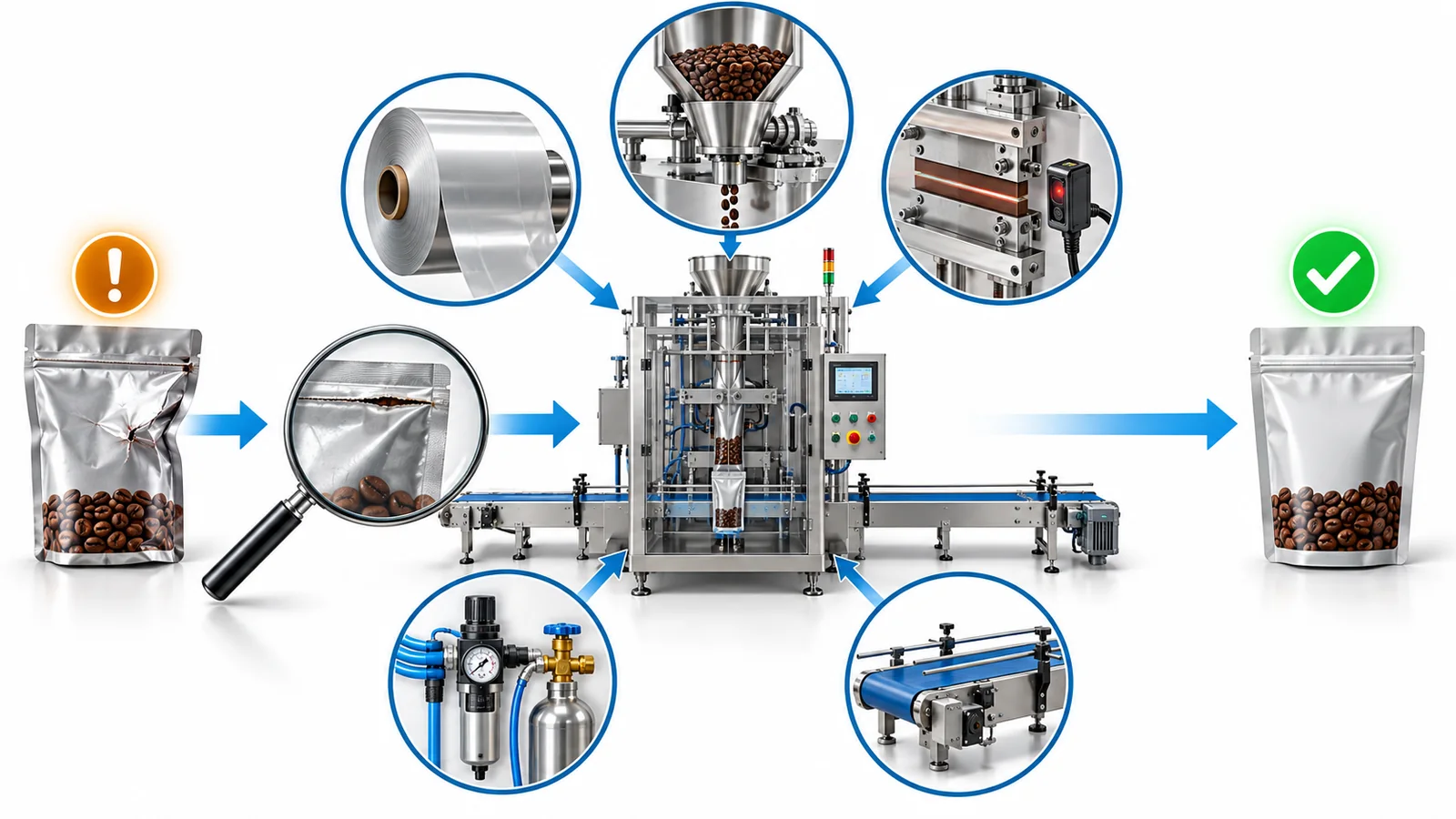
Quick Symptom-to-Cause Matrix
| Symptom | First checks | Common cause families |
|---|---|---|
| Weight varies or drifts | Coffee density/condition, hopper level, buildup, vibration, calibration check | Product variation, feeding instability, dosing wear or setup |
| Weak or leaking seal | Contamination, film/pouch lot, temperature response, pressure, dwell, alignment | Coffee in seal, wrong material window, jaw/band condition |
| Pouch will not open | Pouch tolerance, magazine, vacuum, gripper and static | Package variation, pickup wear, timing or air/vacuum supply |
| Film tracks or registration moves | Roll loading, web path, tension, former, splice and sensor | Material roll, alignment, tension or registration setup |
| Grounds in seal area | Cutoff, chute, settling, extraction, static and speed | Powder behavior, fill path, dust control or timing |
| Residual oxygen unstable | Gas supply, flow, nozzle, timing, headspace, seal and sample method | Supply, purge geometry, speed, leakage or measurement |
| Frequent short stops | Alarm chronology, sensor contamination, accumulation and downstream state | Intermittent input, material handling, interface or recovery logic |
Inaccurate Weight or Excessive Giveaway
Whole beans
Check bean size distribution, fragments, oily surfaces, hopper level, feeder amplitude, weigh-hopper closure, trapped beans, vibration and the approved calibration check. An average on target can still hide excessive spread.
Ground coffee
Check grind, bulk density, temperature, entrained air, hopper head, auger buildup, agitator condition, cutoff and product settling. Do not recalibrate every density change without determining whether the process should instead stabilize product feed.
Verify with individual pack weights across a meaningful run. Record average, spread, underweights and giveaway.
Weak Seals, Channel Leaks or Wrinkles
Keep a failed package and mark its orientation. Check whether the defect repeats at the same jaw position, package side or time in the cycle. Inspect for coffee, folds, zipper or valve interference, material damage, uneven contact and unstable temperature.
Temperature, pressure and dwell work together within the package material’s sealing window. Raising temperature alone may distort material or hide contamination. After correction, inspect finished packs using the site’s defined seal and leak methods.
Premade Pouch Feeding and Opening Problems
- Confirm pouch dimensions, mouth flatness, stiffness, friction, zipper and valve position against the approved sample.
- Load the magazine consistently and remove bent or blocked pouches.
- Inspect suction cups, vacuum level, filters, hoses, grippers and opening confirmation sensors.
- Check whether timing changed with machine speed or pouch size.
- Run approved samples from another lot to separate pouch variation from machine condition.
Rollstock Tracking, Bag Length and Registration Problems
Confirm the roll is centered and correctly wound, the web follows the documented threading path, unwind tension is stable, the forming set is clean and correctly installed, and the registration sensor can see the mark. Inspect the splice and film edges.
Do not use an edge guide to compensate for a crooked roll, damaged film, contaminated roller or misaligned former. Verify bag length, print position, longitudinal seal and cross-seal alignment together.
Ground Coffee Dust and Seal Contamination
First determine where powder escapes: feeder, auger outlet, filling chute, bag impact, withdrawal or sealing motion. Check extraction, static control, fill cutoff, bag opening, settling time and speed. A dirty jaw may be the result rather than the root cause.
Clean using the approved method and then correct the source. Evaluate seals after a sustained production run, not only the first clean packs.
Unstable Nitrogen Flushing
Separate gas input from package result. Check supply capacity and pressure during demand, regulator and flow control, leaks, nozzle position, purge timing, package headspace, time to sealing and residual-oxygen analyzer method. Compare startup, steady production and restart conditions.
Use the dedicated nitrogen flushing guide for coffee packaging to define the validation method. A high-purity supply does not prove low residual oxygen in the finished pack.
Coding, Inspection and Reject Faults
Check code consumables, mounting, trigger, product spacing and recipe. For inspection equipment, challenge the detection and reject sequence using the approved procedure. Verify that a rejected pack is positively removed and contained, and that downstream equipment cannot return it to saleable product.
Recurring Stops and Line-Integration Faults
Read the first alarm in the event sequence rather than the last cascade of alarms. Check ready/run/fault signals, sensor state, accumulation, starved and blocked conditions, upstream replenishment and downstream recovery. If the same short stop repeats, quantify frequency and lost time before changing logic.
ที่ coffee packaging machine process explains how stations depend on each other.
Verify the Fix Before Release
| Evidence | Release question |
|---|---|
| Sustained run | Did the line complete the agreed duration and SKU without recurrence? |
| Weight samples | Are average, spread, underweight and giveaway acceptable? |
| Package checks | Are seals, appearance, code, valve and contamination acceptable? |
| Atmosphere checks | Does residual oxygen meet the defined method where required? |
| Fault recovery | Does the line restart without duplicate fill, empty pack or lost traceability? |
| Record | Were cause, action, setting, parts and verification documented? |
Prepare for an Application Review
Send Hualian your coffee type, fill weights, package drawings and samples, target saleable output, SKU schedule, layout, utilities, inspection needs, and present production problems. The engineering team can then define a testable machine or line scope instead of relying on a generic configuration.
Frequently Asked Questions
Why does a coffee bag seal leak?
Common causes include coffee in the seal, folds, unsuitable material settings, uneven jaw contact, worn components or package features entering the seal.
Why does pack weight change during a run?
Coffee density and flow, hopper level, buildup, vibration, feeder behavior and dosing condition can all change the result.
Why will a premade pouch not open?
Check pouch tolerances and flatness, magazine loading, vacuum, suction cups, grippers, sensors, air supply and timing.
Should you raise seal temperature when seals are weak?
Not automatically. First inspect contamination, material, pressure, dwell, alignment and actual temperature response.
How do you know a fault is fixed?
Run representative production long enough to verify the measurable defect and confirm normal recovery, not just the absence of an alarm.