Перейти к содержанию
Choosing food packaging equipment is not primarily a model-comparison exercise. It is a product–package–process decision. A suitable machine must handle the food at its real production temperature, create the required pack, deliver saleable output, fit the cleaning regime, integrate with the line and produce evidence that agreed requirements have been met.
This practical guide is written for food manufacturers, project engineers and procurement teams preparing a new line, replacing a bottleneck or adding formats. It provides a ten-step route from an initial brief to a testable supplier proposal.
Quick answer
Define the food, finished package, accepted output, hygiene standard, factory interfaces, changeovers and acceptance test before selecting a machine. Compare suppliers against the same written requirement—not nominal speed or purchase price alone.
1. Start With the Food, Not the Machine Catalogue
Describe the food as it reaches the packaging station. Record temperature, viscosity, free liquid, particles, oil, powder or crumbs, fragility, oxygen sensitivity and portion range. Include normal production variation, not only an ideal sample. These characteristics determine how the product can be fed, loaded and sealed.
Also document contamination that may reach the sealing area. Sauce, oil, moisture or powder on a sealing surface can change the process window and inspection method. If multiple recipes or sizes will run on one line, list every SKU and identify the most difficult product.
2. Define the Finished Package and Its Job
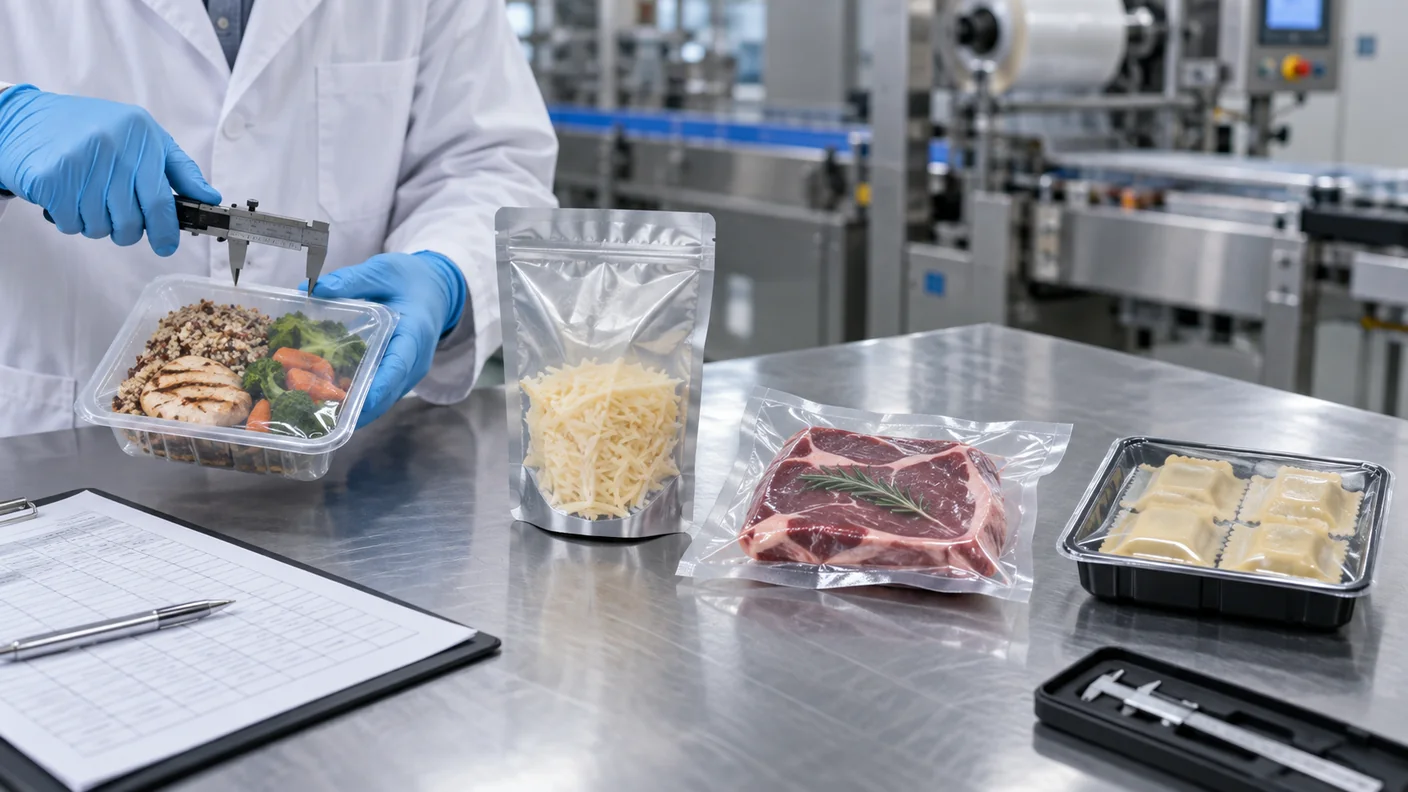
A package is a system of food, container or film, closure, process and storage conditions. Specify dimensions, materials, fill weight, headspace, opening method, label area, distribution case and expected presentation at the point of sale. Provide drawings and physical samples when possible.
- Pouches and bags can minimize material and suit many dry, liquid or portioned foods.
- Preformed trays provide shape and presentation and may support sealing, vacuum, skin or modified-atmosphere processes.
- Vacuum packs remove air around compatible products but require validation for the specific food and storage system.
- Thermoformed packs form the package in line and can suit repeatable, higher-volume production.
For preformed food trays, compare the available tray sealing equipment against tray dimensions, film compatibility and the required packaging process.
3. Select the Packaging Process
Do not treat sealing, vacuum, modified atmosphere and vacuum skin packaging as interchangeable labels. Each changes the process, materials, controls and validation work. A simple heat-sealed tray may be appropriate when containment and presentation are the main objectives. Modified-atmosphere packaging requires gas supply, gas-mixing or flushing controls and verification of the pack atmosphere. Vacuum skin packaging draws the top film closely around the product and tray. Thermoforming adds forming, loading, sealing and cutting stages to the line.
If skin presentation and close product conformity are required, review an automatic thermoforming vacuum skin packaging machine as one possible equipment route—not as a substitute for product and film trials.
4. Calculate Saleable Capacity
Nominal cycles per minute are not the same as saleable packs per shift. First calculate: required accepted packs per minute = required accepted packs per shift ÷ planned production minutes.
Add realistic allowances for cleaning, warm-up, material replenishment, product changes, tooling changes, minor stops and rejects. For multi-cavity equipment, confirm how cavities per cycle, loading time and downstream handling affect output. The slowest sustained stage—not the fastest machine—sets line capacity.
Need to validate a tray-packaging concept?
Send HUALIAN your food description, tray dimensions, film specification, target output and packaging method. The engineering team can use the same inputs to discuss a suitable test path.
5. Match Automation to the Whole Line
Semi-automatic equipment can be rational for lower volume, frequent changes or manual loading. Automatic equipment can reduce repeated handling and stabilize flow when upstream supply, downstream inspection and staffing support it. “Fully automatic” should describe the actual scope: feeding, loading, sealing, discharge, coding, inspection and case handling may still have separate requirements.
Map the line from raw product arrival to finished case. Record conveyor heights, control handshakes, accumulation, reject handling, utilities, operator access and cleaning access. HUALIAN’s guide to customizing an automatic packaging line provides additional planning questions.
6. Evaluate Hygiene and Food-Contact Compliance
Ask suppliers to identify product-contact, splash and non-product zones and explain how each area is accessed, cleaned, drained and inspected. Review surface condition, hollow members, fasteners, cable routing, bearings, lubrication points, removable parts and areas where food or water may collect.
In the United States, FDA food CGMP requirements cover plant equipment, sanitation and process controls. FDA guidance also explains that food equipment and utensils must be designed and constructed so they are adequately cleanable. See the FDA overview of food CGMPs. For the EU market, the European Commission notes that packaging, containers and machinery can fall within food-contact-material rules; verify the materials and declarations relevant to the intended use through its food-contact-material guidance.
EHEDG’s 2026 guidance for thermoforming machinery focuses on open zones, contamination risks and collaboration between machine builders and food producers. It is useful when turning hygiene expectations into equipment questions; see EHEDG Guideline 29 Part 2.
7. Check Safety, Utilities and Factory Fit
Prepare a scaled layout and confirm footprint, working clearances, maintenance access, floor loading and route to installation. List electrical supply, compressed air, cooling water, vacuum and process gas requirements with permitted pressure, quality and consumption ranges.
Risk assessment must reflect the final machine and its interfaces. ISO 12100 provides general principles for machinery risk assessment and risk reduction. For U.S. facilities, OSHA also requires hazards associated with points of operation, power transmission and machine controls to be addressed. Do not assume a line is safe merely because each standalone unit has guarding.
8. Compare Changeover, Controls and Support
Ask for a witnessed changeover using representative parts. Record the number and weight of change parts, tools required, recipe handling, adjustment points and time from the last acceptable pack of one SKU to the first acceptable pack of the next. Confirm backup, access levels, language options, alarm history and data export.
Support capability should be evaluated before purchase. PMMI’s 2025 workforce study drew on 136 end-user and OEM respondents and highlighted demand for machine-embedded HMIs, predictive maintenance, remote OEM support, short task-based videos and QR-linked documentation. See PMMI’s Inside the Workforce Gap report.
9. Compare Total Cost, Not Purchase Price Alone
Build one cost model for every candidate. Include tooling, freight, installation, validation, utilities, labor, materials, planned maintenance, wear parts, cleaning time, changeovers, expected rejects and downtime risk. Record every assumption and use the same production horizon.
Supplier Comparison Scorecard
Assign each criterion a weight totaling 100, score each supplier from 1 to 5, and multiply weight by score. Keep mandatory requirements as pass/fail gates rather than hiding them inside a total.
| Criterion | Weight | Evidence |
|---|---|---|
| Package quality and accepted output | 25 | Representative product trial |
| Hygiene and cleanability | 20 | Design review and cleaning procedure |
| Changeover and SKU fit | 15 | Witnessed format change |
| Integration and safety | 15 | Layout, interfaces and risk documents |
| Lifecycle cost | 15 | Consumption and maintenance assumptions |
| Service and documentation | 10 | Support plan, manuals and spares list |
10. Turn the RFQ Into an Acceptance Test
Your RFQ should state the product, package, materials, output definition, utilities, interfaces, deliverables and acceptance criteria. Require suppliers to list assumptions and exclusions. Before ordering, agree which products and materials will be tested, run duration, sampling method, acceptable defects, output calculation and closure of open items.
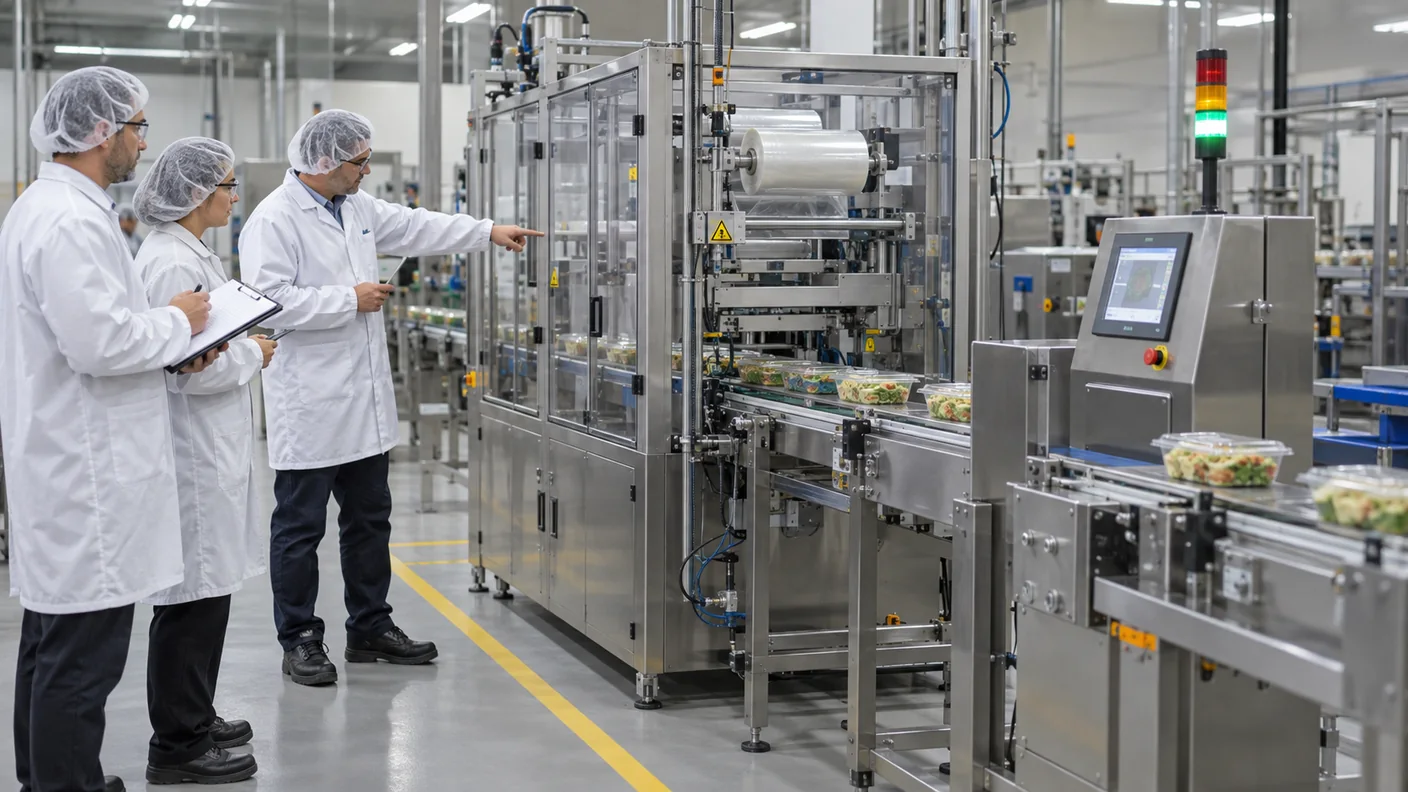
A factory acceptance test should verify contracted functions; it is not simply a demonstration that the machine starts. Record settings, samples, results, deviations and responsibilities. For forming applications, a thermoforming vacuum packaging system should be evaluated with intended materials, product loading and downstream requirements.
Questions to Send With Your RFQ
- Which product and packaging assumptions support the quoted output?
- How is an accepted pack defined and measured?
- Which parts contact food, and how are they removed and cleaned?
- Which formats are included, and what additional tooling is required?
- What are the utility quality, pressure and consumption requirements?
- What upstream and downstream interfaces are included?
- Which trials, documents, training and spare parts are included?
- What will be demonstrated during the factory acceptance test?
Turn your requirements into a comparable proposal
Share representative product details, package samples, output targets, SKU list and factory conditions with HUALIAN. A clearer brief produces a more useful equipment discussion and a more testable quotation.
Frequently Asked Questions
What information should I prepare before requesting a quote?
Prepare food characteristics, fill range, package drawings or samples, accepted output, SKU list, cleaning method, utilities, layout, interfaces and acceptance criteria.
Should I choose the package or the machine first?
Define the product and finished-package requirements first. Machine selection follows from handling, forming, sealing, atmosphere, output and validation needs.
How should I compare machine capacity?
Compare accepted packs per minute or shift under the same product, materials, staffing and test conditions. Account for cavities, stops, changeovers and rejects.
When is automatic equipment worth considering?
Automation is valuable when it removes a documented constraint and the complete line can supply, inspect and discharge product consistently.
What should an equipment trial prove?
It should demonstrate package quality, accepted output and stable operation using representative product and materials under an agreed test plan.
How do I evaluate hygienic design?
Review food-contact zones, accessibility, drainage, surface condition, material compatibility, removable parts and the documented cleaning and inspection procedure.
What costs are commonly missed?
Tooling, installation, utilities, packaging-material consumption, cleaning time, changeovers, rejects, wear parts, training, spares and downtime risk are frequently omitted.
Related Resources
- How to Choose the Right Tray Sealing Machine
- Recommended next guide: Food Packaging Machine RFQ Checklist
- Recommended next guide: How to Calculate Food Packaging Machine Capacity
Compliance, shelf life and package performance depend on the food, materials, process, market and facility. Validate the final system with qualified food-safety, packaging and engineering personnel.