Перейти к содержанию
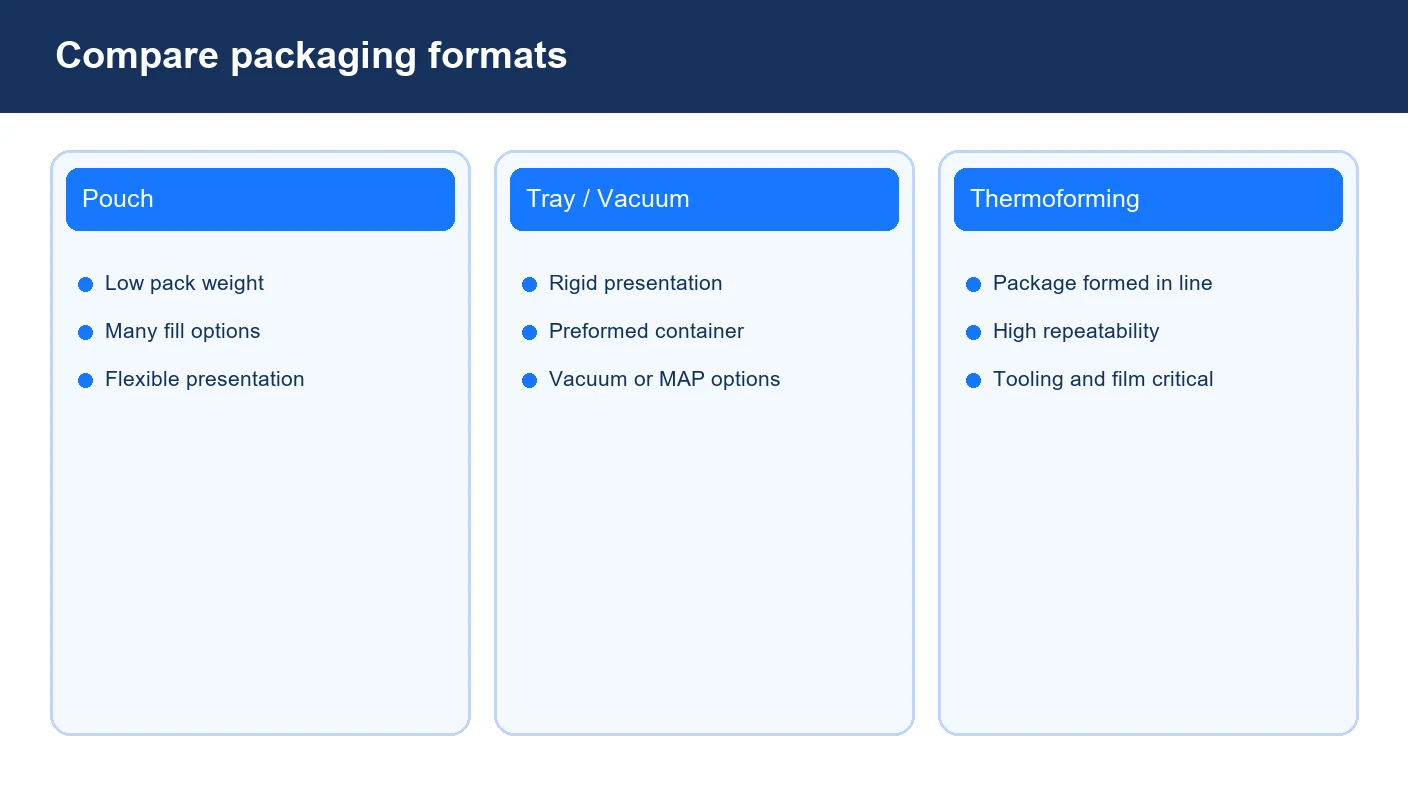
Choose a food packaging format by defining product protection, presentation, storage, distribution and production requirements. Pouches, preformed trays, vacuum packs and thermoformed packs solve different combinations of these needs. This comparison helps buyers eliminate unsuitable routes before requesting equipment proposals.
Buyer focus: Use the article as a screening framework. Final equipment suitability must be confirmed with representative product, packaging material and acceptance criteria.
Quick Packaging Format Comparison
| Format | Useful when | Confirm before selection |
|---|---|---|
| Pouch | Flexible pack and broad size options are needed | Pouch style, dosing, seal area and material |
| Tray | Shape and retail presentation matter | Tray flange, lidding film and tooling |
| Вакуум | Air removal is part of the process | Product response, bag structure and seal |
| Thermoforming | Rollstock formation and integrated sealing fit the volume | Web structure, forming depth, tooling and loading |
When to Choose Pouch Packaging
Pouches can be formed from rollstock or supplied premade. The decision affects artwork, material use, feeding, zipper or spout handling, changeovers and machine type. Confirm whether the product can be dosed cleanly without contaminating the seal area.
When to Choose Preformed Tray Packaging
Trays support product shape and presentation and can be sealed with a lidding film. Geometry, flange flatness, nesting, denesting and film compatibility must be evaluated together. Review the tray sealer selection guide for equipment-level decisions.
When to Choose Vacuum Packaging
Vacuum packaging removes air before the package is sealed. The product must tolerate the pressure change and package contact expected from the chosen process. The achievable result depends on the complete product, material, seal and storage system, so shelf life must be validated rather than assumed.
When Thermoforming Fits the Project
Thermoforming creates the lower package from rollstock and seals it with a top web after loading. It can consolidate forming and sealing, but requires decisions about forming depth, web properties, tooling, product loading and format changes.
Compare Presentation, Materials and Operations
Evaluate shelf appearance, opening method, portion control, label area, material supply, storage space and waste handling. Then compare operator tasks, changeover, cleaning, utilities and the downstream case or distribution format.
Validate the Product–Package Combination
Run trials with the intended food, container or film, storage condition and acceptance methods. A visually attractive sample is not enough; record dimensions, sealing conditions, defects and any difference from production materials.
Move From Format Choice to Equipment Selection
Once the format is defined, use the equipment-type guide to shortlist machine families, then return to the food packaging equipment buyer’s guide.

Evidence and standards to verify
Food equipment selection should reflect applicable hygiene and safety requirements. FDA CGMP guidance addresses cleanable food equipment; ISO 12100 provides machinery risk-assessment principles; and PMMI’s 2025 workforce study reports findings from 136 end-user and OEM respondents on skills, embedded guidance, remote support and targeted automation.
Frequently Asked Questions
Is vacuum packaging a container format or a process?
It is primarily a process. It can be applied to compatible bags, formed packs and some tray-based systems.
Can the same product use both pouches and trays?
Yes, but each combination requires its own material, equipment, handling and validation decisions.
Does thermoforming always replace tray sealing?
No. Thermoforming creates a package from rollstock, while tray sealing closes a preformed tray. Their economics and operating requirements differ.
Which format usually offers the most presentation rigidity?
A preformed tray generally provides more structure than a flexible pouch, although final performance depends on tray and lidding specifications.
Does vacuum packaging always extend shelf life?
No. Shelf life depends on the food, process, residual atmosphere, barrier, seal integrity, hygiene and storage temperature and must be validated.
When does thermoforming become attractive?
It becomes attractive when forming packages in line, repeatable output and material use justify tooling, line length and changeover requirements.
Discuss a testable packaging requirement with HUALIAN
Send product details, package samples, target output, SKU range and factory conditions. Use the same written requirement when comparing suppliers.
Related Resources
- How to Choose Food Packaging Equipment: A Practical Buyer’s Guide
- Food Packaging Equipment Hygienic Design Checklist
- Food Packaging Machine Factory Acceptance Test Checklist