Перейти к содержанию
A coffee packaging machine turns bulk coffee and packaging material into measured, closed, identifiable packs through a controlled sequence of stations.
Quick answer: Coffee enters a feeding and dosing system; a rollstock machine forms a bag while a premade-pouch machine opens an existing one. The machine then fills the dose, manages the package atmosphere when required, seals, codes, inspects, and discharges the pack. The line works only when these stations exchange product and status signals at a compatible rate.
This article goes deeper than our coffee packaging machine guide and focuses on one specific equipment decision.
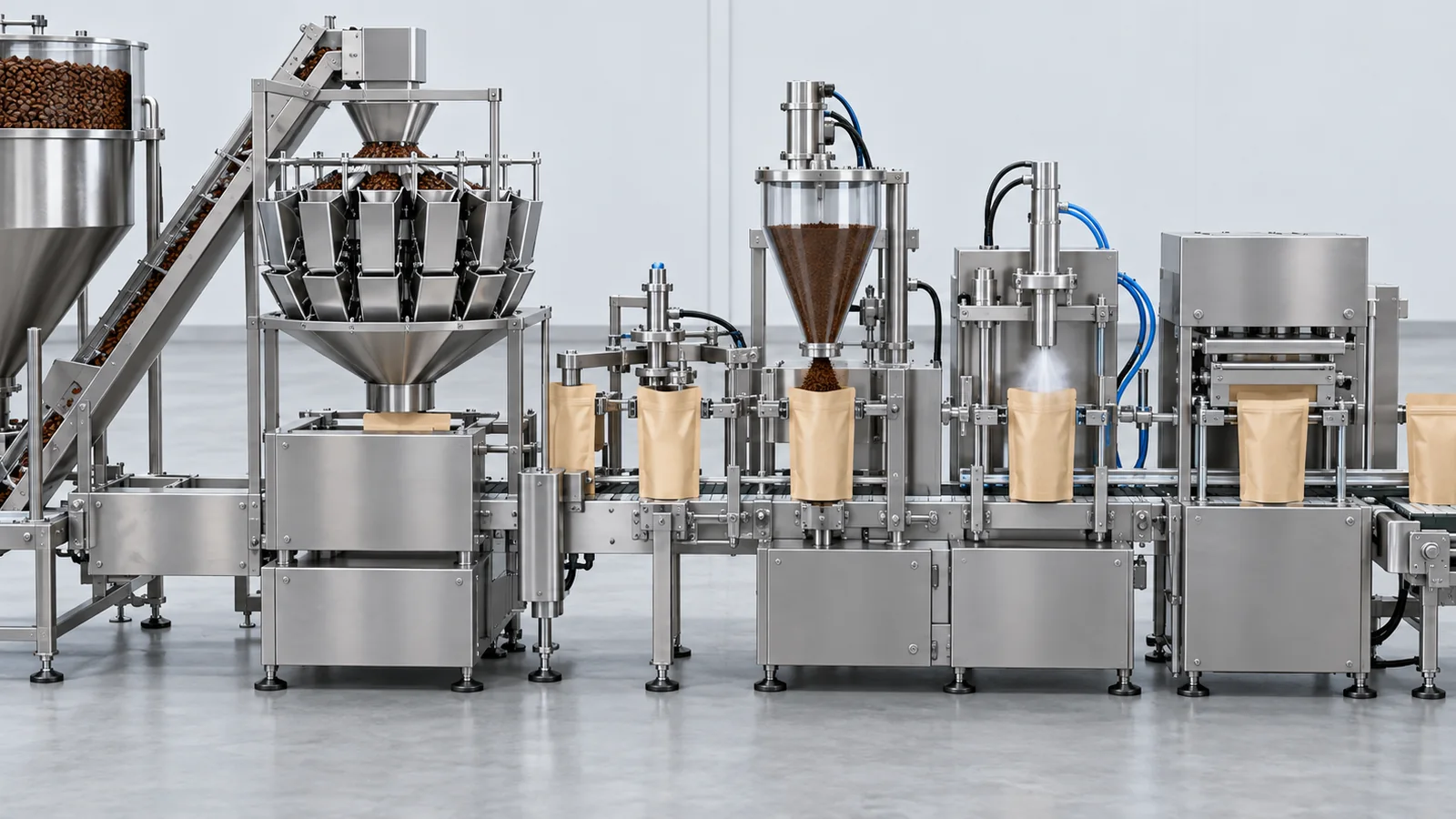
The Complete Coffee Packaging Process
| Этап | Main job | Critical output |
|---|---|---|
| 1. Product infeed | Move coffee from storage to the dosing hopper | Stable, gentle supply without starvation or overflow |
| 2. Dosing | Measure each portion | Target weight with controlled variation |
| 3. Package preparation | Form a bag or open a premade pouch | Correct geometry and reliable opening |
| 4. Filling | Transfer the measured coffee | Clean seal area and limited product damage |
| 5. Atmosphere control | Flush gas or apply vacuum when specified | Measured package-atmosphere result |
| 6. Sealing | Apply heat, pressure, and dwell time | Continuous, repeatable seal |
| 7. Coding and inspection | Identify and verify the pack | Readable code and accepted weight/seal |
| 8. Discharge | Move packs downstream | No jams, crushing, or line imbalance |
1. Product Feeding Keeps the Doser Supplied
Whole beans, ground coffee, and soluble products do not flow in the same way. A hopper, elevator, vacuum conveyor, or screw conveyor transfers product to the dosing unit. Level sensors request more product and stop the feeder before overfilling.
For beans, examine drop height and impact points. For grounds, examine dust, compaction, static, and oil. A packaging machine may stop even when its own mechanisms are healthy if the upstream feeder cannot maintain a stable product level.
2. The Dosing System Measures Each Pack
Whole beans
Multihead, linear, or net weighers measure beans by weight. The relevant result is not one accurate bag; it is the distribution of weights during a sustained run, together with bean breakage and giveaway.
Ground coffee
An auger filler meters powder through screw rotation. Its result can change with grind, bulk density, hopper level, entrained air, and product condition. Check weights across multiple batches and operating conditions.
3. The Machine Forms a Bag or Opens a Premade Pouch
A VFFS machine unwinds film, guides it around a forming collar, creates a tube, makes the longitudinal seal, and uses cross-seal jaws to create the bottom and top seals. A premade-pouch machine instead picks a converted pouch, grips it, opens it, and presents it to the fill station.
These routes require different evidence. For rollstock, confirm structure, thickness, web width, roll dimensions, registration marks, and sealing window. For premade pouches, confirm size tolerance, mouth flatness, stiffness, friction, zipper, and valve position. See the types of coffee packaging machines for the wider category comparison.
4. Filling Must Protect the Seal Area
The doser releases coffee through a chute or filling funnel. Timing matters: the bag must be present and open, the dose must clear the path, and the sealing components must not close on product. Sensors commonly prevent filling when a pouch is missing.
Ground coffee in the seal area can interrupt heat transfer and create channels or weak spots. Countermeasures may include dust extraction, longer settling time, controlled product cutoff, antistatic measures, or a revised filling path. Validate the result with actual coffee at production speed.
5. Nitrogen Flushing or Vacuum Changes the Package Atmosphere
When specified, nitrogen is introduced before final sealing to displace oxygen-rich air. Vacuum equipment removes air and may backfill gas. Neither method proves freshness by itself: the coffee condition, barrier material, seal integrity, valve strategy, and storage conditions also matter.
Measure residual oxygen in finished packs instead of using nitrogen purity or gas flow as a substitute. The Specialty Coffee Association describes oxygen, moisture, temperature, and time as important freshness factors in its coffee freshness overview.
6. Heat Sealing Creates the Final Closure
Heat sealing depends on temperature, pressure, dwell time, material structure, jaw condition, and a clean seal area. More heat is not always the answer: excess heat can distort film or reduce the usable operating window.
During validation, record seal settings and inspect for wrinkles, contamination, incomplete bonding, channel leaks, and visual defects. Agree on an acceptable pack before the factory acceptance test.
7. Coding, Inspection, and Rejection Protect Output Quality
A coder may apply date, batch, or traceability information. A checkweigher can identify underweight or overweight packs, while other inspection equipment may verify contaminants, code presence, or package condition. Define how rejects are confirmed and contained so they cannot return to saleable output.
8. Controls Synchronize the Complete Line
The PLC coordinates motors, heaters, sensors, alarms, recipes, and safety devices. In a connected line, machines also exchange ready, run, stop, fault, and accumulation signals. The slowest reliable station determines output.
Ask what happens after a missing pouch, low product level, film splice, downstream stop, or rejected pack. Recovery logic often matters more than the maximum cycle rate shown in a short demonstration.
Core Components to Inspect
- Product hopper, feeder, and level sensors
- Weigher, auger, or volumetric dosing system
- Film unwind and forming set or pouch magazine and grippers
- Filling chute and dust-control provisions
- Gas nozzles, valves, flow controls, or vacuum chamber
- Sealing jaws, heaters, temperature control, and cooling
- Coder, checkweigher, inspection, and reject device
- PLC, HMI, drives, safety circuit, guards, and interlocks
- Conveyors and upstream/downstream interfaces
What to Verify During a Factory Acceptance Test
| Metric | Question to answer |
|---|---|
| Sustained saleable output | Can the complete line run at the required rate under agreed conditions? |
| Weight distribution | Are average weight and variation acceptable without excessive giveaway? |
| Seal quality | Are seals continuous and repeatable with production material? |
| Residual oxygen | Does the finished pack meet the agreed method and target? |
| Reject logic | Are faults detected, removed, and recorded correctly? |
| Changeover | Can trained operators complete it safely within the agreed scope? |
| Recovery | Does the line restart predictably after realistic stops? |
Prepare the Information for an Application Review
Send Hualian your coffee type, fill weight, package drawings and samples, target saleable output, SKU schedule, utility information, and required inspection scope. These inputs allow the engineering team to define a testable configuration instead of assuming that a standard machine will fit.
Frequently Asked Questions
Does every coffee packaging machine form the bag?
No. VFFS machines form bags from rollstock, while premade-pouch machines fill and seal bags made beforehand.
How does a machine measure coffee beans?
Whole beans are commonly measured with a multihead, linear, or net weighing system.
How does a machine fill ground coffee?
Ground coffee is commonly metered by an auger filler, but the configuration must be tested for density and dust behavior.
Where does nitrogen flushing happen?
It normally happens after filling and before final sealing, although the exact arrangement depends on the machine and package.
What controls packaging speed?
Usable output is limited by the slowest reliable station and by stops, replenishment, inspection, and downstream handling.