Ir al contenido
Total cost of ownership compares equipment over a defined operating period rather than comparing purchase price alone. The calculation should use the same products, package formats, production schedule and financial assumptions for every option. Its value comes from exposing cost drivers and uncertainty, not producing an artificially precise number.
Buyer focus: Treat this guide as a requirement-building tool. Confirm final equipment suitability with representative product, packaging materials, factory conditions and written acceptance criteria.
Set the Comparison Boundary
Choose the evaluation period, production volume, shifts, SKU mix and included line scope. State whether the model covers only the primary machine or also feeding, conveyors, inspection, coding and end-of-line equipment.
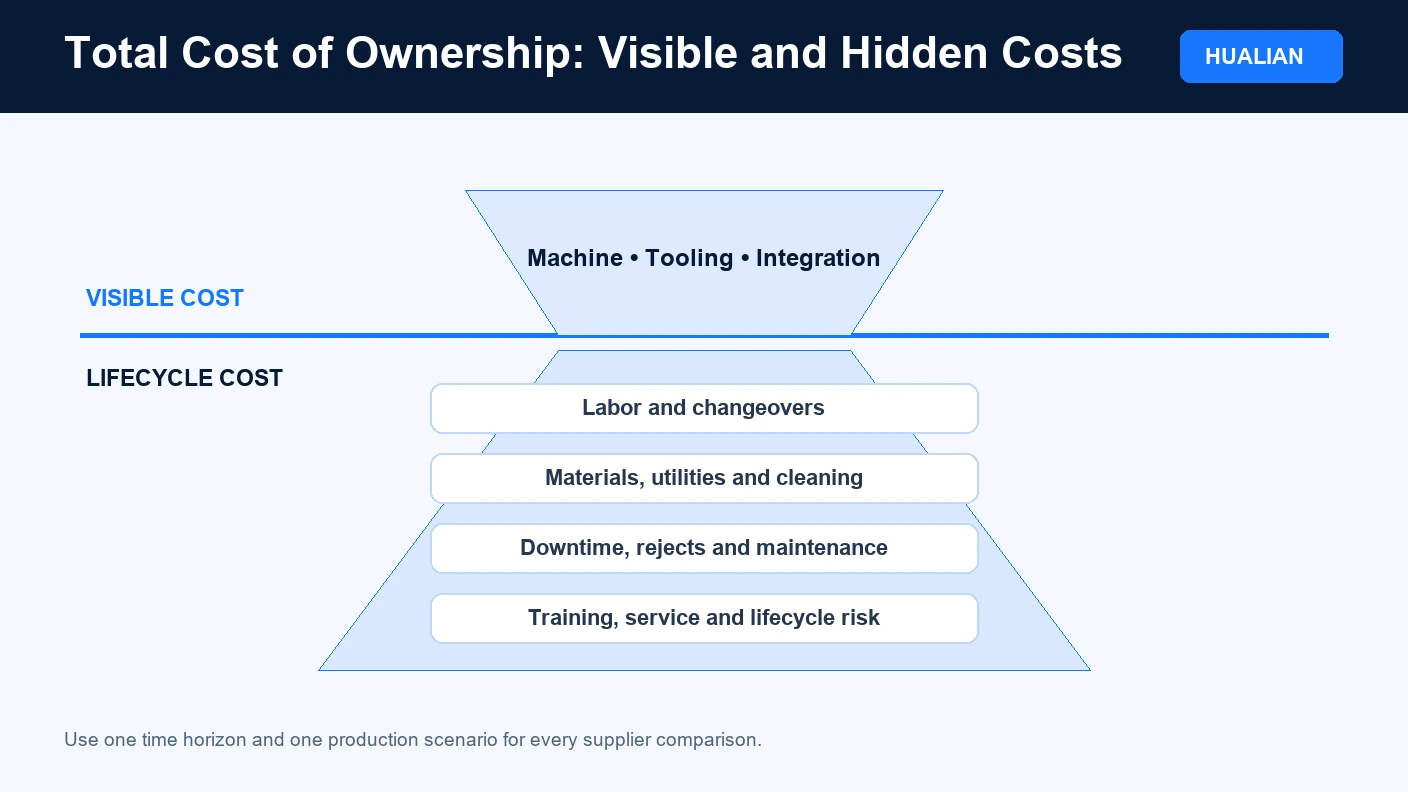
Calculate Acquisition and Installation
- Machine and included options
- Tooling and change parts
- Freight, duties and insurance
- Site preparation and utilities
- Installation and commissioning
- Training, validation and initial spares
Calculate Labor
Map staffing by activity: operation, material replenishment, inspection, cleaning, changeover, maintenance and supervision. Use local loaded labor costs and realistic operating hours. Do not assume quoted automation eliminates all labor.
Calculate Materials and Product Loss
Compare packaging-material consumption, trim or film waste, start-up packs, product giveaway, rejects and rework. Use trials or controlled production evidence where available and show uncertainty when data are preliminary.
Calculate Utilities and Consumables
List electricity, compressed air, gases, water, cleaning chemicals, labels, ink, lubricants and other consumables relevant to the proposed process. Base the model on the intended duty cycle, not only installed power.
Calculate Maintenance and Downtime
Include preventive-maintenance labor, wear parts, critical spares, service travel, software or support arrangements and the cost of unavailable production. Ask suppliers which assumptions are supported and which remain the buyer’s responsibility.
Include Changeovers and SKU Complexity
Calculate lost production, labor and start-up waste for planned changes. A flexible machine may justify a higher purchase price when the real schedule contains many short runs. Use the multi-SKU planning guide to build the input matrix.
Compare Scenarios and Sensitivity
Create at least a base case and credible high- and low-utilization cases. Test the variables most likely to change the decision, such as labor, film cost, demand, downtime and changeover frequency. Avoid treating residual value or future demand as certain.
Use TCO With Technical Evidence
A favorable model does not prove product compatibility or output. Link financial comparison to the RFQ, sample trial and acceptance plan. Return to the food packaging equipment buyer’s guide for the complete decision sequence.
Build a Comparable Cost Model
Use the same production horizon, shifts, SKU mix, labor rates, material specifications and service assumptions for every option. Separate cash costs from operational risks. If a supplier’s quotation excludes conveyors, tooling, compressors, installation or validation, add those items before comparing totals.
A simple annual model can use: annual ownership cost = annualized acquisition and integration + labor + packaging materials + utilities + maintenance + quality losses + expected downtime cost. Keep assumptions visible so operations, finance and engineering can challenge them.
Test the Variables That Drive the Decision
Run sensitivity cases for material price, labor rate, changeover time, reject rate and unplanned downtime. A small purchase-price advantage can disappear if a machine consumes more film, requires more operators or creates longer cleaning stops. Conversely, a higher-cost system is not automatically better; savings must be supported by trial data, references or contractual acceptance criteria.
Standards and Industry References
The following resources provide general guidance for equipment selection and review. Final requirements should be determined according to applicable regulations, customer standards and site-specific risk assessments.
Frequently Asked Questions
What does total cost of ownership include?
It includes acquisition, tooling, integration, labor, materials, utilities, maintenance, downtime, rejects, training and end-of-life costs over a defined period.
How many years should a TCO model cover?
Use the company investment horizon and expected equipment life, then test shorter and longer scenarios because forecasts become less certain over time.
How should downtime be valued?
Use lost contribution, overtime, scrap, delayed orders or other site-approved costs and document the assumed frequency and duration.
Should packaging material cost be included?
Yes. Film, trays, bags, labels and consumables often accumulate into a major lifecycle cost and should be compared at equivalent package performance.
How can suppliers support a TCO comparison?
Ask for utility consumption, staffing assumptions, wear-part lists, maintenance intervals, changeover data and trial results under the same written specification.
Is the lowest TCO always the best choice?
No. The model supports a decision, but food safety, product quality, capacity, serviceability and strategic risk still require explicit acceptance criteria.
Turn your requirement into a testable HUALIAN proposal
Send product details, package samples, output targets, SKU range and factory conditions. We can review an appropriate equipment path and the evidence needed before purchase.
Related Resources
- How to Choose Food Packaging Equipment: A Practical Buyer’s Guide
- Food Packaging Machine RFQ Checklist
- Recommended next guide: How to Calculate Food Packaging Machine Capacity