Skip to content
Manual carton sealing and strapping create bottlenecks in shipping departments. An integrated carton sealing system automates both processes—closing flaps, applying tape, and adding plastic straps—in a single continuous line. Here’s how a carton sealing line works and why operations are making the switch.
What is a Carton Sealing Line?
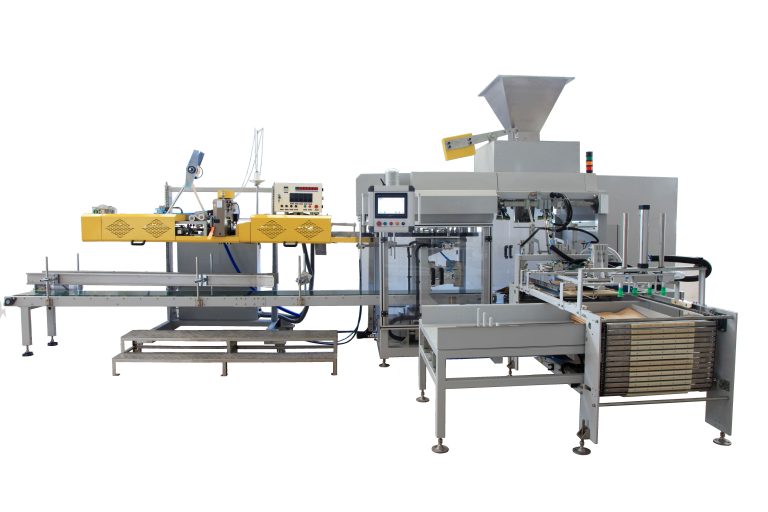
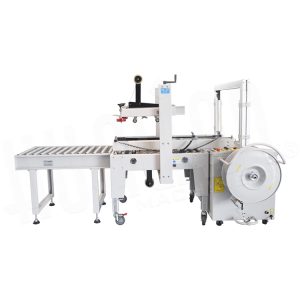
A carton sealing line is an integrated end-of-line packaging solution that automatically seals carton flaps with adhesive tape and applies plastic strapping in a single continuous operation. Think of it as a compact production line that replaces two separate manual tasks—taping and banding—with a fully automated, conveyor-fed system. Cartons enter one side; by the time they exit, they are securely sealed and strapped, ready for palletizing or shipping.
This type of automatic carton sealing line is widely used across food and beverage, e-commerce, electronics, pharmaceuticals, and logistics—any industry that ships products in corrugated cartons and requires strong, tamper-evident packaging. Automation in packaging lines can reduce labor costs by over 50% while significantly enhancing packaging efficiency and product presentation.

Key Components of the Carton Packaging Line
A typical carton packaging line comprises three core modules working in sequence:
Carton Sealing Machine (Case Sealer)
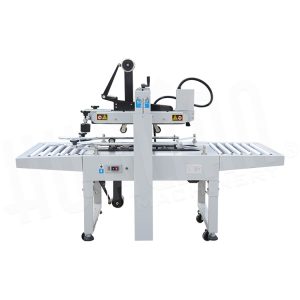
Also referred to as a case sealer or box sealing machine, the carton sealing machine is the first station in the line. It automatically folds the top and bottom flaps of each carton and applies adhesive tape along the center seam. High-quality case sealers use side-belt drive systems to smoothly transport cartons through the sealing zone without stopping, ensuring consistent tape application regardless of carton size variations.
Automatic Strapping Machine
Once the carton is sealed, it moves to the strapping machine. This unit applies one or more polypropylene (PP) straps around the carton, tightly tensioning and heat-sealing the strap ends. For extra security, the system can apply two straps or a full cross pattern (“#” strapping). The strapping process significantly increases package strength, preventing cartons from bursting open during stacking or transit.
Conveyor System
The conveyor system links the sealing and strapping stations, creating a smooth, uninterrupted material flow. Sensors and PLC controls coordinate the entire process—when a sealed carton reaches the strapping unit, the conveyor automatically pauses to allow strapping, then resumes to discharge the finished package.
How Does a Carton Sealing Line Work?
Carton Feeding
Filled cartons with manually or automatically folded flaps are placed onto the infeed conveyor. The conveyor transports each carton into the case sealer, where side belts center and stabilize the box for accurate flap folding and tape application.
Automatic Sealing
Inside the case sealing system, mechanical guides fold the top flaps into position. The tape head then applies pressure-sensitive adhesive tape along the top center seam, while a bottom taping unit simultaneously seals the bottom flaps. This dual-sided sealing ensures complete closure without manual intervention. Some modern case sealing systems incorporate water-activated or hot-melt adhesive options for enhanced seal integrity.
Strapping Process
The sealed carton travels along the conveyor to the strapping station. Photoelectric sensors detect the carton’s position, and the automatic strapping machine automatically feeds a PP strap around the box, tensions it to a preset force, and heat-seals the overlapping ends. This step is crucial for load stability during stacking and shipment.
Output and Transfer
Once strapped, the finished carton is discharged onto an outfeed conveyor, ready for manual or automated palletizing. The entire process—from feeding to strapped output—takes just seconds per carton, with production speeds reaching up to 600 cartons per hour depending on the model.
Find Your Carton Packaging Line at Hualian
With extensive experience in packaging machinery, Hualian provides a range of carton sealing and strapping packaging lines designed for different automation levels. These systems integrate carton sealing and strapping into a continuous workflow to improve packaging efficiency.
| Model | Configuration | Key Feature | Max Capacity |
|---|---|---|---|
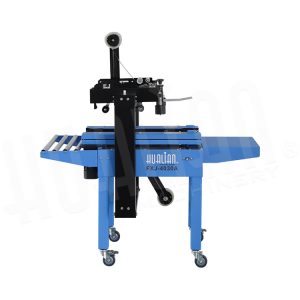
| XFK-1 Series | Carton sealer + strapping machine + conveyor | Basic integrated packaging line | Up to 600 pcs/h |
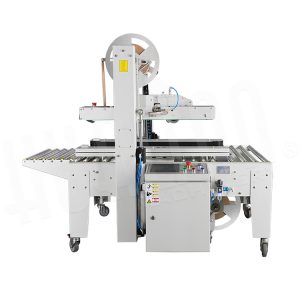
| XFK-2 Series | Auto flap carton sealer + strapping machine + conveyor | Automatic flap folding and sealing | Up to 600 pcs/h |
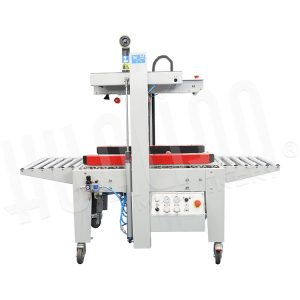
| XFK-3 Series | Multi-conveyor + auto sealer + multiple strapping machines | Continuous automated packaging line | Up to 600 pcs/h |
XFK-1 Series
The XFK-1 series is a basic carton sealing and strapping line composed of a carton sealer, automatic strapping machine, and conveyor system. It supports continuous packaging operations with a production capacity of up to 600 cartons per hour.
The system is compatible with cartons up to 600 × 500 × 500 mm, with a minimum size of 300 × 130 × 180 mm. It operates at a conveying speed of 16 m/min and supports standard BOPP or PVC adhesive tape as well as plastic strapping belts (9–15 mm width).
XFK-2 Series
The XFK-2 series features an automatic flap-folding carton sealer combined with a strapping machine and conveyor system. It automates the carton sealing process by folding flaps and applying adhesive tape before strapping.
This series operates at a total power of 1700W, with a production capacity of 600 cartons per hour. It supports carton sizes from 180 × 260 × 180 mm to 600 × 500 × 500 mm, and uses standard adhesive tapes and plastic strapping belts.
Air pressure requirements for the system are 0.5–0.6 MPa, ensuring stable operation of pneumatic components.
XFK-3 Series
The XFK-3 series is a fully integrated packaging line with multiple conveyor sections, carton sealing equipment, and automatic strapping machines. It is designed for continuous, higher-efficiency packaging processes.
The system operates at a total power of 4100W, with a conveying speed of 16 m/min and a production capacity of up to 600 cartons per hour. It supports carton sizes ranging from 180 × 260 × 180 mm to 500 × 400 × 450 mm. Like other models, it uses BOPP or PVC adhesive tape and plastic strapping belts (9–15 mm width).
Why Choose Hualian End-of-line Packaging Solutions
Hualian has been a trusted manufacturer of packaging machinery since 1989, with facilities spanning over 100,000 square meters and a product portfolio covering 16 series with more than 200 varieties. Our carton sealing and strapping lines are engineered for:
-
Reliability – Robust construction ensures continuous, trouble-free operation day after day
-
Flexibility – Modular designs allow integration with upstream carton erectors or downstream palletizers
-
Ease of Use – User-friendly PLC controls and quick-change adjustments for varying carton sizes minimize downtime
-
Global Support – With over 100 countries served, Hualian offers local service and spare parts availability–
Hualian Machinery Group is an executive director unit of the China Packaging Federation, a high-tech enterprise in Zhejiang Province, and a drafting unit for China’s national industry standards in packaging machinery. The company has passed ISO9001:2008 certification, with main products carrying EU CE certification—demonstrating commitment to quality that matters to industrial buyers.
FAQs
Can carton sealing and strapping be automated together?
Yes—an integrated carton sealing system combines both processes into a single automated line, eliminating manual handling between stations and improving throughput while reducing labor dependency.
What industries benefit from packaging automation lines?
Food and beverage, e-commerce fulfillment, electronics manufacturing, pharmaceuticals, cosmetics, logistics distribution centers, and any industry shipping products in corrugated cartons.
What are the benefits of carton sealing and strapping packaging lines?
Reduced labor costs, faster throughput (up to 600 cartons per hour), consistent seal and strap tension for superior transit security, lower material waste, and the ability to redeploy staff to higher-value tasks.
Conclusion
A carton sealing line automates two critical end-of-line tasks—sealing and strapping—into one smooth, efficient workflow. The result is faster output, lower labor dependence, and secure packaging that withstands the rigors of shipping. Hualian’s XFK series lines are tailored to different volume and budget requirements, all backed by decades of engineering expertise and global support. Explore Hualian’s carton sealing strapping solutions at Our Web.