Skip to content
Introduction
In the era of personalized production and diversified market demand, one-size-fits-all packaging production lines can no longer meet the operational needs of modern enterprises. Customized automated packaging production lines that match the characteristics of enterprises, product attributes, and production scale have become the core choice for enterprises to improve production efficiency, reduce costs, and enhance core competitiveness. As a leading packaging equipment supplier who has been deeply engaged in industrial packaging solutions and packaging system design for decades, serving thousands of enterprises in various industries such as chemical, food and beverage, medicine, feed, automotive parts, etc., we provide customized packaging solutions and integrated packaging systems tailored to each customer. This article details the 8 key steps of customized automation packaging production lines, and explains why Hualian is the best partner for enterprises to build customized packaging production lines.
Step 1: Assess Your Business Needs
The first and most critical step in customizing an automated packaging production line is to conduct a comprehensive and in-depth assessment of the enterprise’s needs, which is the foundation of the entire packaging system design. The evaluation needs to cover three core dimensions of product characteristics, production scale, and industry attributes, and form a detailed requirement report to avoid blind design and equipment mismatch.
Product characteristics: Specify the physical form of the product (powder, granule, liquid, solid), shape, weight, packaging form (bag, box, bottle, ton bag) and packaging material (plastic, paper, metal); For special products such as corrosive chemical products, sterile pharmaceutical products, and fragile food products, special requirements for the packaging production line need to be marked separately.
Production scale: Determine daily/hourly production, peak production demand (seasonal fluctuations), and production shift arrangement; Distinguishing between small batch multi-variety and large batch single-variety production modes directly affects the automation level and equipment selection of the packaging production line.
Industry attributes: Adhere to industry regulatory standards, such as GMP standards in the pharmaceutical industry, food safety regulations in the food and beverage industry, and anti-explosion requirements in the chemical industry; The packaging production line design must meet the corresponding environmental and safety regulations.
Hualian will send a professional technical team to conduct an on-site inspection, form a standardized demand evaluation report based on the description of customer needs, and lay a solid foundation for the design of customized packaging solutions.
Step 2: Define Packaging Line Goals
Based on the evaluation results of enterprise needs, it is necessary to formulate clear and quantifiable production line construction goals, which is the core direction of packaging system design and the basis for subsequent effect evaluation. The objectives should be closely linked to the enterprise’s development strategy, focusing on efficiency improvement, cost reduction, quality control, and scalability, and quantifying the indicators as much as possible.
Efficiency goals: such as increasing the hourly packaging output by 50%, shortening the packaging cycle of a single product by 30%, or achieving 7×24 continuous production.
Cost objectives: such as reducing labor costs by 40%, reducing material waste by 20%, or reducing equipment maintenance costs by 15%.
Quality objectives: such as controlling the filling accuracy error within ± 0.5%, ensuring the packaging qualification rate of 99.9%, or meeting the industry traceability requirements.
Scalable goals: such as supporting 100% capacity expansion in the next 3-5 years, or being able to adapt to more than 10 new product packaging without large-scale equipment modification.
Hualian will work with enterprises to set personalized production line goals, combining industry data and actual cases to ensure that the goals are practical and achievable, and avoid setting goals that are too high or too low to affect the design effect.
Step 3: Select the Right Machines
Selecting suitable packaging equipment is the core link of a customized automated packaging production line, and the matching degree of equipment directly determines the operation efficiency of the entire integrated packaging system. The selection of equipment should follow the principles of matching product characteristics, matching production scale, and supporting integration, and select professional equipment for each process such as weighing, filling, sealing, labeling, and stacking on the packaging production line.
Hualian has a full range of packaging equipment covering all processes, and can provide targeted selection suggestions according to the needs of enterprises. The table below is Hualian’s core equipment matching for different types of products, which is the key reference for industrial packaging solutions:
| Product Type | Core Packaging Process | Hualian Recommended Equipment | Core Features |
| Powder | Weighing → Filling → Dust-Free Sealing → Palletizing | Screw Filler, Dust-Free Sealing Machine, Robotic Palletizer | High filling accuracy, dust collection, and closed operation |
| Granules | Multi-Head Weighing → Automatic Filling → Sewing → Labeling | Multi-Head Scale, Vertical Filler, Fully Automatic Sewing Machine, Intelligent Labeling Machine | Fast weighing speed, stable filling, and clear labeling |
| Liquids | Quantitative Filling → Capping → Leak Detection → Packing | Piston Filler, Fully Automatic Capping Machine, Leak Detector, Packing Machine | Adaptable to different viscosities, no dripping, 100% leak detection |
| Solids | Sorting → Packaging → Strapping → Palletizing | Automatic Sorting Machine, Blister Packaging Machine, Strapping Machine, Gantry Palletizer | Precise sorting, strong strapping, high load-bearing capacity |
Step 4: Design Workflow and Layout
The scientific production process and reasonable workshop layout are the key to ensure the smooth operation of the automated packaging production line and reduce unnecessary material transportation and time loss. The packaging system design of the process flow and layout should follow the principles of the shortest material flow, no bottleneck in the process, and ergonomics, and design the most suitable scheme in combination with the enterprise’s factory area, height, power supply, and other site conditions.
- Process Flow Design
According to the product characteristics and production goals, optimize the packaging process, eliminate redundant links, and ensure that each process seamlessly connects from raw materials to finished goods palletizing. For example, for powder products, add a dust collection link between filling and sealing; For sterile pharmaceutical products, an additional disinfection step should be added before packaging. The core of the process design is to improve production efficiency and ensure product quality.
- Workshop Layout Design
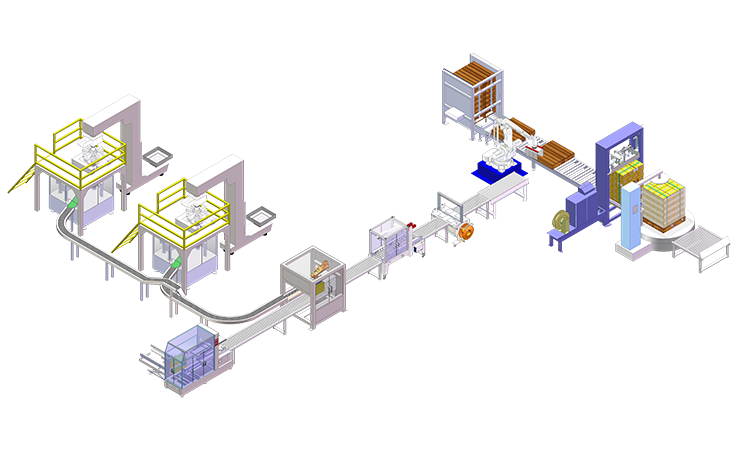
According to the shape of the workshop and the scale of production, the three mainstream layouts are straight, U-shaped, and L-shaped, each with its own applicable scenario:
Linear layout: Suitable for large factory area, large batch single product production, simple process, fast production speed;
U-shaped layout: Suitable for small factory areas, maximizing space utilization, and easy for operators to manage and maintain equipment;
L-shaped layout: Suitable for irregular factory shapes, inspection and quality control can be set up at the turning point to ensure product quality.
Hualian adopts 3D simulation software for production line layout design, which visualizes the arrangement of equipment, the flow of materials, and the activity area of operators, and adjusts the layout according to the enterprise’s suggestions to avoid layout defects in the construction site.
Step 5: Integrate Automation and Robotics
The integration of automation and robotics technology is the key to realizing the intelligence of automated packaging production lines and improving production efficiency and packaging consistency. With the development of Industry 4.0, the integration of automation and robots is no longer an optional upgrade, but an essential component of modern customized packaging solutions and industrial packaging solutions.
The integrated content mainly includes two aspects: automation systems and robot applications:
- Automation system: PLC programmable logic controller is used to realize centralized control of the entire production line, and all equipment is connected through a unified communication protocol to realize automatic start-stop, parameter adjustment, and fault alarm; Intelligent sensors such as weight, vision, and leak detection are added to realize real-time monitoring and quality control of each process.
- Robot applications: Introduce professional robots for repetitive and heavy-duty processes, such as robot palletizers for the palletizing process, grasping robots for the sorting and packing process, and robot sealers for the high-precision sealing process. The robot can realize 7×24 hours of uninterrupted operation, eliminate manual errors, and ensure the consistency of packaging quality.
The integrated packaging system of Hualian has a high degree of automation and robot integration. The automation level can be customized according to the enterprise budget and production goals – from semi-automatic to fully automatic, from single-process robot application to full-line intelligent robot operation, to achieve a step-by-step upgrade of the production line without repeated investment.
Step 6: Test and Validate the Line
After completing the packaging system design and equipment installation, it is necessary to carry out comprehensive testing and verification of the entire automated packaging production line, which is the key to ensuring that the production line meets the design goals and enterprise needs, and avoiding formal operation faults and production losses. The test verification is divided into two stages: factory test and on-site commissioning test, with clear test indicators and acceptance standards.
- Factory testing
Before the equipment leaves the factory, Hualian will conduct a full-process simulation test of the production line in the factory, using actual products or simulated samples of the customer, to test the overall line operation efficiency, packaging quality, equipment coordination, and fault handling ability; Unqualified equipment will be adjusted and modified in a timely manner until it meets the design requirements.
- On-site commissioning and trial operation
After the on-site installation of the equipment is completed, the Hualian professional technical team will conduct a continuous operation test of the production line (usually 72 hours of uninterrupted operation), testing the real production efficiency, product qualification rate and equipment stability under the actual production conditions of the enterprise; At the same time, verify whether the production line conforms to the industry regulatory standards and predetermined production goals.
Only when the production line passes all test indicators and is accepted by the enterprise, Hualian will complete the handover of the production line. If problems are found during testing, Hualian will solve them in a timely manner and will never delay the formal production of the enterprise.
Step 7: Train Staff and Implement SOPs
A well-designed automated packaging production line cannot achieve its maximum efficiency without professional operation and standardized management. Professional training for operators and the implementation of standardized operation instructions (SOPs) are key to ensuring the long-term stable operation of production lines and reducing equipment failures and human errors.
Hualian provides one-stop training services for enterprise operators and maintenance personnel, covering three core contents:
- Operation training: Teaching employees equipment operation, parameter adjustment, product formula switching and simple fault handling; Practical teaching is the main method to ensure that each operator can master the operation skills.
- Maintenance training: Teaching maintenance personnel the daily inspection, regular maintenance, replacement of wear-and-tear parts and common fault diagnosis of equipment; Provide detailed maintenance manuals to reduce equipment failure rates.
- Safety training: Popularize the safety operation norms of the production line, especially the safety precautions of automated and robot equipment, to avoid safety accidents caused by improper operation.
At the same time, Hualian will work with enterprises to develop detailed SOPs for production lines, including operating procedures for each shift, equipment maintenance cycles, quality inspection standards, and fault reporting procedures, to achieve standardized management of production lines.
Step 8: Continuous Improvement
Customizing an automated packaging production line is not a one-time project, but a process of continuous optimization and upgrading. With the development of enterprises (expansion of production scale, launch of new products) and the update of packaging technology, the production line needs to be constantly adjusted and upgraded to adapt to new enterprise needs – this is also the core of the scalability of packaging system design and the key to enterprises to maintain long-term competitiveness.
The continuous optimization of the production line mainly includes two aspects:
- Daily optimization: Real-time collection of production line operation data (production efficiency, product pass rate, equipment failure rate), analysis of existing problems and bottlenecks, timely adjustment of process parameters and equipment operation mode, and improvement of overall line operation efficiency.
- Phase-by-phase upgrade: According to the enterprise development strategy, phase-by-phase upgrade of the production line, such as improving the level of automation, adding new equipment to adapt to new product packaging, and expanding the production capacity of the production line; The modular design of Hualian equipment can realize non-stop upgrading, avoiding production impact on the enterprise.
Hualian will establish a long-term follow-up service mechanism for each customer, regularly track the operation of the production line, provide professional optimization suggestions, assist enterprises in completing the phased upgrade of the production line, and ensure that the automated packaging production line is always matched with the enterprise’s needs.
Why Working with Hualian
As a company deeply engaged in industrial packaging solutions and customized packaging solutions, with rich experience, the top packaging equipment supplier, Hualian, has become the first choice for thousands of enterprises to customize automated packaging production lines with professional technical strength, all-category product layout, personalized design ability, and perfect after-sales service. The core advantages of cooperating with Hualian are reflected in the following 6 aspects, which are also the key to maintaining Hualian’s leading position in the packaging system design industry:
| Advantages and Specific | Achievements |
| Extensive Industry Experience | Decades of service to industries including chemicals, food and beverage, pharmaceuticals, feed, and auto parts; familiar with regulatory standards and packaging requirements across various sectors. |
| Full Product Coverage | Possesses packaging equipment for the entire process, including weighing, filling, sealing, labeling, and palletizing; one-stop procurement, eliminating the need to deal with multiple suppliers. |
| Personalized Customized Design | Creates customized packaging solutions based on your company’s actual needs; supports flexible customization of automation level, layout, and equipment matching. |
| High-Level Integration Capabilities | Creates seamless integrated packaging systems; achieves interconnectivity and deep integration of automation and robotics technologies. |
| Professional One-Stop Service | Covers on-site surveys, needs assessment, design, production, installation, commissioning, training, and subsequent optimization; one-stop solution for all issues throughout the process. |
| Comprehensive After-Sales Service | Establishes a global after-sales service network; 24/7 on-site repair, long-term supply of spare parts, regular follow-up optimization; ensures a low failure rate for the entire production line. |
FAQs
How do I start designing a packaging line?
Start with a comprehensive assessment of product characteristics, production scale, and industry attributes, and work with professional packaging equipment suppliers to form a demand report.
Can packaging lines be expanded later?
Yes. The Hualian production line adopts a modular design, supports capacity expansion and new product adaptation, and does not require large-scale renovation.
Can one line package different products?
Yes. The Hualian production line is equipped with a rapid change system and formula storage function, which supports multi-variety packaging and has extremely short downtime.
Does customization increase packaging efficiency?
Yes. The customized production line is highly matched with the enterprise’s needs, eliminating production bottlenecks, and the overall packaging efficiency can be improved by 30% to 60%.
How do I choose a packaging line manufacturer?
Focus on industry experience, product coverage, integration capability, after-sales service, and project cases, such as Hualian with full-chain service capability.
Conclusion
Customized automation packaging production line is a systematic project, involving eight steps: demand assessment, goal setting, equipment selection, layout design, automation integration, test verification, employee training, and continuous optimization. Each step is interlinked and affects the final operation of the production line. A customized automated packaging production line that meets the needs of enterprises can not only improve the production efficiency and packaging quality of enterprises, but also reduce the overall operating costs, and lay a solid foundation for the scale expansion and digital transformation of enterprises.
As a professional packaging equipment supplier who has been deeply engaged in industrial packaging solutions and customized packaging solutions for many years, based on the actual needs of enterprises, with rich industry experience, comprehensive product coverage, high-standard packaging system design ability, and perfect one-stop service, we provide customized integrated packaging systems and automated packaging production lines for enterprises in various industries. From the initial on-site survey to the long-term follow-up optimization, Hualian has always been with the enterprise, solving all the problems in the production line construction and operation, and becoming the most reliable partner for the enterprise’s packaging automation upgrade.