Skip to content
Multi-SKU equipment planning begins with a controlled matrix of every product, pack size, material and required process. Buyers can then identify what changes mechanically, digitally and hygienically between runs. This prevents “flexible” from remaining an undefined sales claim and turns it into a testable operating requirement.
Buyer focus: Treat this guide as a requirement-building tool. Confirm final equipment suitability with representative product, packaging materials, factory conditions and written acceptance criteria.
Build the Product–Package Matrix
| Field | Record for each SKU |
|---|---|
| Product | Form, condition, fill range and handling limits |
| Package | Dimensions, material, closure and artwork |
| Process | Fill, atmosphere, seal and inspection steps |
| Schedule | Batch size, frequency and sequence |
| Changeover | Parts, settings, cleaning and approval checks |
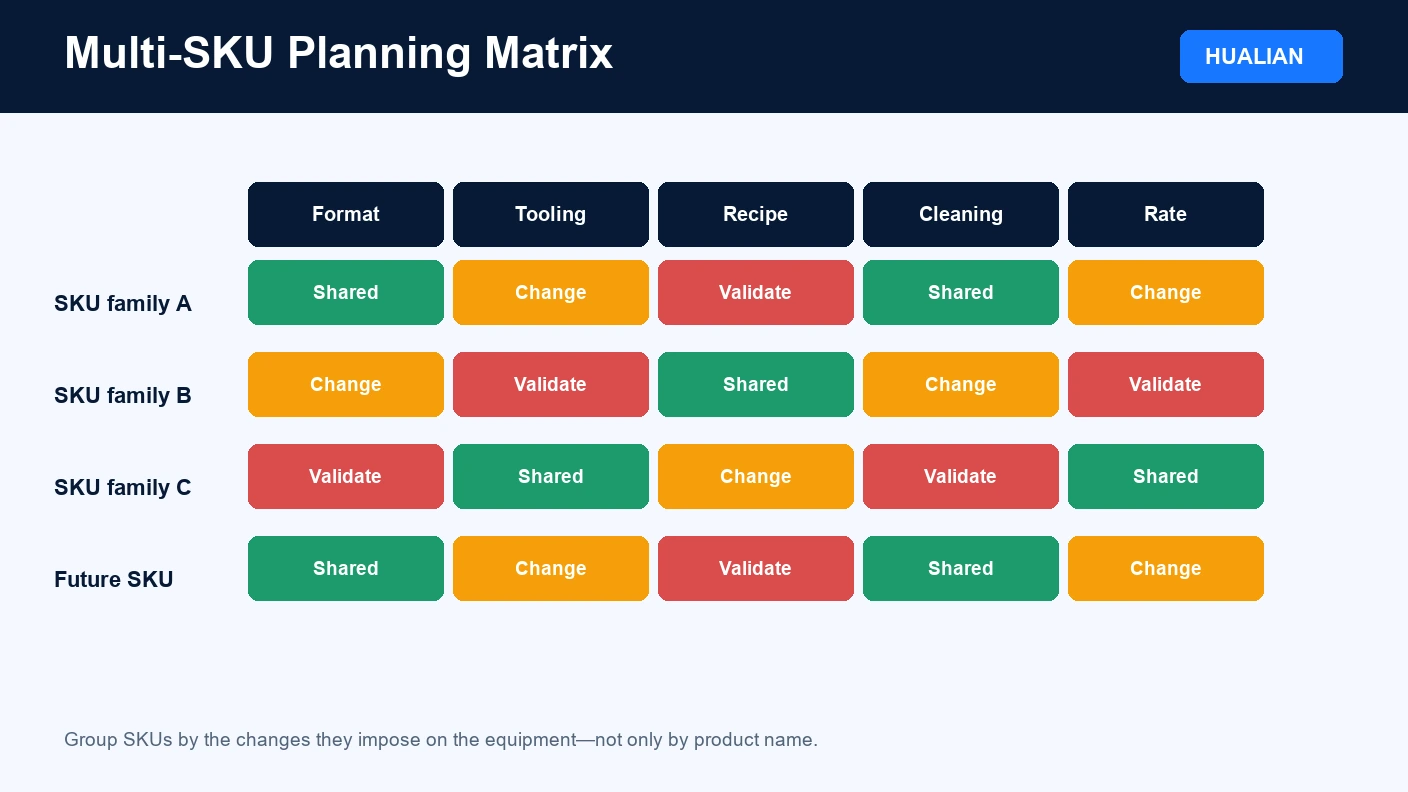
Group Similar SKUs
Create families that share product behavior, package geometry, tooling and cleaning needs. Do not group items solely because their marketing names are similar. Identify the largest, smallest and most difficult combinations in each family.
Identify Every Change Point
List hoppers, fillers, guides, forming sets, sealing tools, trays, film widths, recipes, printers, labels, conveyors and inspection settings. Ask which changes are tool-free, which require lifting and which require a qualified adjustment.
Plan Recipes and Parameter Control
Define who can create, approve and change recipes, how versions are identified and how a correct setup is confirmed. A stored recipe reduces repeated entry but does not prove that mechanical components or materials are correct.
Include Cleaning and Cross-Contact
Sequence products to reduce unnecessary cleaning where permitted by the site’s validated controls. Record disassembly, cleaning, inspection, reassembly and release time rather than measuring only the mechanical tool swap.
Measure a Complete Changeover
Use the interval from the last acceptable pack of the outgoing SKU to the first approved pack of the incoming SKU. Record labor, tools, adjustments, rejected packs and interruptions. This definition connects changeover work with saleable capacity.
Decide Between Flexible and Dedicated Lines
A shared line can reduce duplicated equipment but may create scheduling and cleaning constraints. Dedicated equipment can isolate products or protect capacity but increases asset scope. Compare both routes using demand, risk, space, staffing and total cost.
Test Representative and Difficult Formats
The sample plan should cover the range rather than testing only the easiest SKU. Define which formats will be tested at the supplier and which require site conditions. Use the FAT checklist to document evidence.
Connect SKU Planning With Equipment Selection
Apply the matrix to capacity, automation, hygiene and TCO calculations. Return to the food packaging equipment buyer’s guide for the complete selection framework.
Create SKU Families Instead of Treating Every SKU Separately
Group SKUs by the factors that actually change the machine: package footprint, fill range, product handling, atmosphere, sealing recipe, label data and cleaning requirement. A color or flavor change may require only a recipe and label update, while a tray footprint change may require tooling, guides and a different lidding web.
For each family, record the nominal rate, validated operating window, change parts, cleaning level and sequence restrictions. This exposes where one platform can share equipment and where a separate machine or offline preparation step reduces risk.
Plan Capacity With the Real SKU Mix
Nominal speed is not enough. Subtract product changeovers, format changes, cleaning, material replenishment, quality checks and planned maintenance from available time. Sequence compatible SKUs together and test both the average week and the peak-season mix. The result should show accepted packs per shift, not theoretical cycles per minute.

Standards and Industry References
The following resources provide general guidance for equipment selection and review. Final requirements should be determined according to applicable regulations, customer standards and site-specific risk assessments.
Frequently Asked Questions
What is an SKU matrix for packaging equipment?
It is a table linking every product and package combination to format, materials, tooling, recipe, cleaning, output and validation requirements.
How should SKUs be grouped?
Group them by the changes they impose on the machine, such as package footprint, fill range, sealing recipe, atmosphere or sanitation level.
When is dedicated equipment justified?
Dedicated equipment may be justified when cross-contact risk, changeover loss, incompatible formats or peak demand makes a shared platform impractical.
How should changeover time be specified?
Define the start and finish conditions, people available, tools, cleaning scope and acceptable first-good-pack criteria, then measure the complete event.
Can one packaging machine run all future SKUs?
Rarely without limits. Define a realistic design envelope and reserve space, controls or interfaces only for credible future requirements.
What samples should suppliers receive?
Provide representative extremes: smallest and largest packs, most difficult product, typical materials and expected variation, not only the easiest SKU.
Turn your requirement into a testable HUALIAN proposal
Send product details, package samples, output targets, SKU range and factory conditions. We can review an appropriate equipment path and the evidence needed before purchase.
Related Resources
- How to Choose Food Packaging Equipment: A Practical Buyer’s Guide
- Food Packaging Machine RFQ Checklist
- Recommended next guide: How to Calculate Food Packaging Machine Capacity