Skip to content
Packaging capacity should be expressed as acceptable finished packs over available production time. Catalogue speed alone does not account for cleaning, changeovers, minor stops, rejects or an upstream process that cannot supply product consistently. This method converts demand into a testable line requirement.
Buyer focus: Use the article as a screening framework. Final equipment suitability must be confirmed with representative product, packaging material and acceptance criteria.
Start With Required Saleable Packs
Define demand by SKU and time period, then add the approved planning allowance for peaks or growth. Separate units, cases, weight and packs so the calculation does not mix measures. If one pack contains several portions, document that conversion.
Convert Demand Into Packs per Minute
Required average rate = required acceptable packs ÷ available production minutes. Available minutes exclude planned non-production periods. Keep the assumptions visible so procurement and operations are comparing the same scenario.
Separate Rated Speed From Sustained Output
Rated cycles may describe a machine under defined conditions; saleable output includes only accepted packs. Ask what product, package, test duration, staffing and upstream supply were used when a speed was demonstrated.
Account for Availability, Performance and Quality Losses
A practical model separates stopped time, running-speed losses and rejected output. Overall Equipment Effectiveness combines availability, performance and quality, but the inputs must use a consistent time basis. Use historical line data when it is reliable; otherwise show the assumption as a range rather than presenting false precision.
Identify the Line Bottleneck
List the sustained capacity of feeding, dosing, packaging, inspection, cartoning and transfer steps. Consider accumulation and starved or blocked conditions. The slowest constrained step governs the connected line, not the fastest machine.
Include Changeovers and Multiple SKUs
Calculate product, film, tray, tooling, recipe and cleaning changes over the planned schedule. A high theoretical rate may be less useful than a flexible system when short runs and frequent changes dominate. Use the multi-SKU planning guide for the format matrix.
Verify Capacity During the FAT
Define saleable packs, the test duration, permitted interventions, reject rules and how stops will be recorded. Include representative product and packaging material. Carry site-dependent interfaces into the SAT plan instead of treating an isolated factory run as complete line proof.
Capacity Calculation Checklist
- Demand and pack conversion by SKU
- Available minutes by shift
- Planned cleaning and changeovers
- Expected stop, speed and quality losses
- Upstream and downstream capacities
- Peak demand and expansion allowance
- FAT measurement and acceptance method
Return to the equipment buyer’s guide to connect capacity with format, automation and supplier selection.

Evidence and standards to verify
Food equipment selection should reflect applicable hygiene and safety requirements. FDA CGMP guidance addresses cleanable food equipment; ISO 12100 provides machinery risk-assessment principles; and PMMI’s 2025 workforce study reports findings from 136 end-user and OEM respondents on skills, embedded guidance, remote support and targeted automation.
Frequently Asked Questions
Should capacity be based on cycles or finished packs?
Use acceptable finished packs because cycles can include empty, incomplete or rejected packages.
How much spare capacity should I add?
There is no universal percentage. Base the allowance on demand variability, growth plans, maintenance strategy and the cost of insufficient capacity.
Can a short demonstration prove production capacity?
It can confirm some functions, but sustained performance requires agreed conditions, duration, materials and stop-recording rules.
What is the difference between cycle speed and pack output?
Cycle speed counts machine cycles; pack output also depends on cavities per cycle, accepted quality and sustained operating time.
Should peak demand or average demand be used?
Test both. Average demand supports normal planning, while peak demand reveals whether overtime, inventory or additional capacity is required.
How should changeovers be included?
Subtract planned changeover time from available production time and use observed or trial-based durations for the real SKU mix.
Discuss a testable packaging requirement with HUALIAN
Send product details, package samples, target output, SKU range and factory conditions. Use the same written requirement when comparing suppliers.
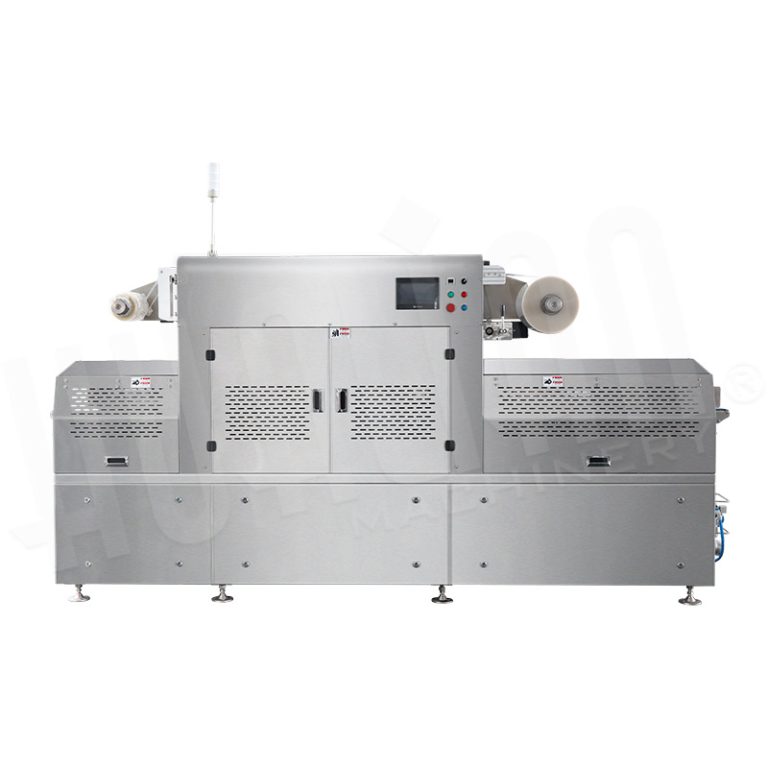
Review Automatic Compact MAP Thermoforming Vacuum Packaging Machine
Related Resources
- How to Choose Food Packaging Equipment: A Practical Buyer’s Guide
- Food Packaging Equipment Hygienic Design Checklist
- Food Packaging Machine Factory Acceptance Test Checklist